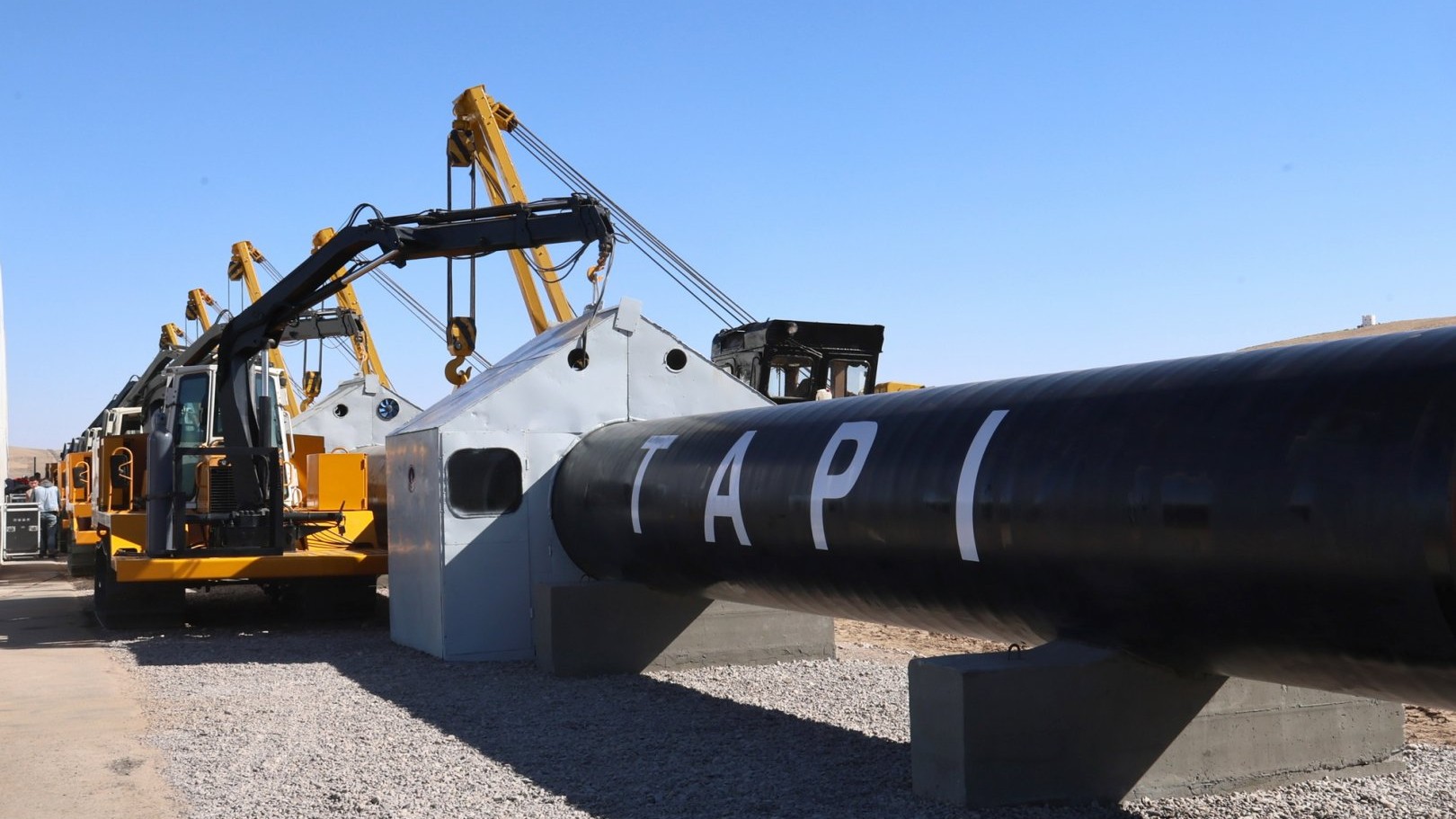
The Kabul Tribune (KT) — Azerbaijani media outlet Trend News Agency has reported that the Turkmenistan-Afghanistan-Pakistan-India (TAPI) pipeline project is gaining renewed strategic importance amid rising gas demand in Asia and growing fragmentation in the global energy market.
According to the report published Jan. 30, increasing
competition for energy resources, geopolitical risks and concerns over energy
security have reshaped global supply strategies, particularly in Asia, where
demand continues to grow rapidly.
Trend cited data from the International Energy Agency (IEA)
indicating that India’s natural gas consumption is projected to increase by
nearly 60% — from 65 billion cubic meters in 2023 to 103 billion cubic meters
by 2030. The share of gas in India’s energy mix is expected to rise from 6.2%
in 2025 to 15% by 2030. India currently imports about 44% of its natural gas,
roughly half of which arrives as liquefied natural gas (LNG).
In this context, the TAPI pipeline is viewed as a key
project aimed at diversifying supply routes and reducing reliance on maritime
LNG shipments. The pipeline is designed to transport up to 33 billion cubic
meters of gas annually over approximately 1,814 kilometers from Turkmenistan’s
Galkynysh gas field, which holds proven reserves of 27.4 trillion cubic meters.
Under the project plan, Afghanistan would receive 5 billion
cubic meters of gas per year, while Pakistan and India would each receive 14
billion cubic meters.
Trend reported that Turkmenistan has completed construction
of its 214-kilometer section of the pipeline and prepared it for operation in
2024. Work on the Afghan section began in September 2024. Of the 153-kilometer
Serhetabat-Herat segment, 91 kilometers have been prepared for pipe laying. As
of late 2025, approximately 14 kilometers of pipeline had been laid in
Afghanistan, with completion of the section expected by the end of 2026.
For Afghanistan, the project carries particular significance.
More than 85% of the country’s electricity is imported, primarily from
Uzbekistan, Turkmenistan and Iran, alongside limited domestic hydro, thermal
and renewable generation. While domestic gas demand remains relatively low, the
pipeline is seen as a potential driver for infrastructure development and
reduction of the country’s energy deficit.
In January 2026, India’s ambassador to Turkmenistan
expressed readiness to expand cooperation in information technology,
digitalization, healthcare, pharmaceuticals and human resource development,
emphasizing the mutually beneficial use of natural resources. Later that month,
India’s Secretary of State for Western Affairs, Sibi George, visited Ashgabat
for energy-related discussions.
At the “Turkmenistan Oil & Gas – 2025” conference, TAPI
Pipeline Company Limited CEO Muhammetmyrat Amanov said the goal is to complete
construction of the Herat section by the end of 2026 and begin gas deliveries
by late 2026 or early 2027. He also stated that negotiations with Pakistan on
key investment protection agreements are in their final stage, with more than
90% completed.
Trend reported that Turkmenistan aims to strengthen its
position in South Asian energy markets. Preliminary estimates suggest that by
2030, Turkmenistan could supply 13% to 14% of total gas imports to the region’s
1.5 billion consumers if the TAPI project is fully implemented.
The report also highlighted a December 2025 World Economic
Forum study titled “The AI-Energy Nexus Will Determine AI’s Impact: We Must Account
for It Better,” which warned that countries unable to ensure reliable and
sustainable energy supplies risk falling behind in the global race for
artificial intelligence development.
According to Trend, China has already secured long-term
natural gas supply partnerships with Turkmenistan, while India is increasingly
focusing on the country’s energy potential. The successful implementation of
the TAPI project could strengthen Turkmenistan’s role as a key energy exporter
and enhance regional integration between Central and South Asia, the report
said.





