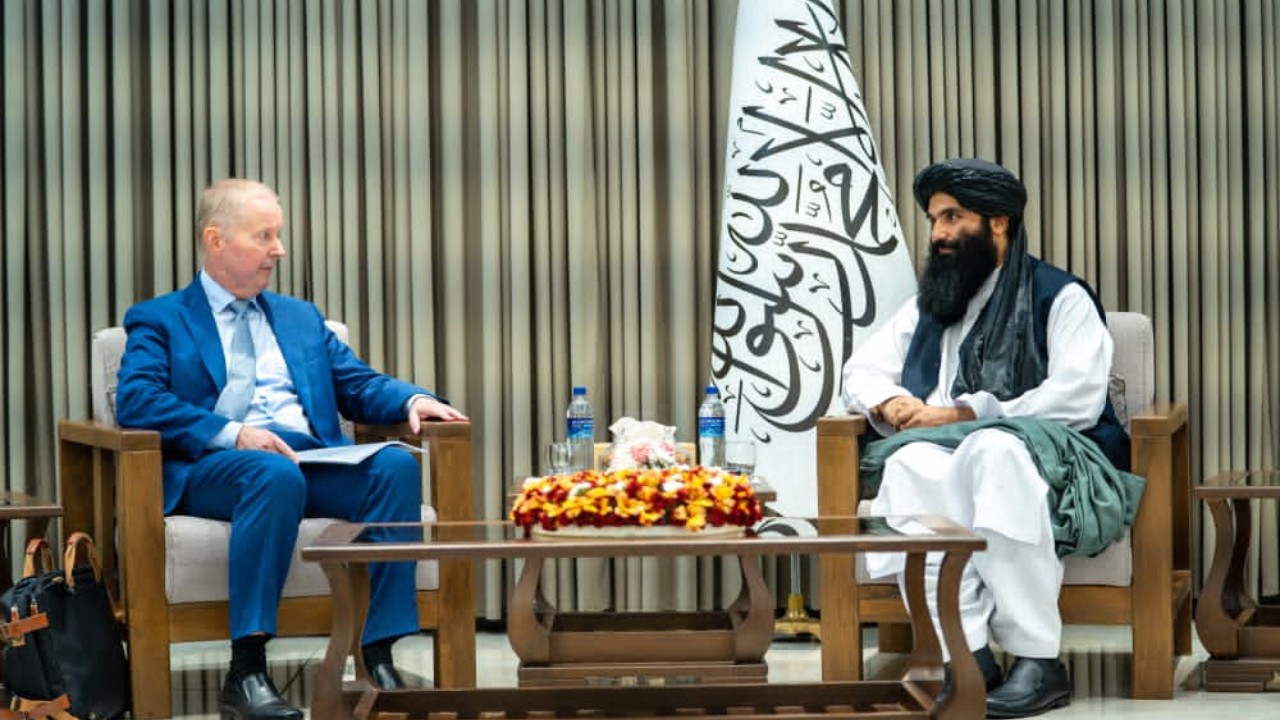
The Kabul Tribune (KT) — The European Union’s special envoy for Afghanistan reiterated the bloc’s strong concerns over restrictions on women and girls during a visit to Kabul, saying the measures remain a key obstacle to normalizing relations with Afghanistan, according to an EU statement.
Thomas Frellesen, the EU special envoy for Afghanistan,
visited Kabul from Oct. 12 to 14 and held talks with representatives of
Afghanistan’s Taliban authorities, members of the diplomatic community,
regional partners, the United Nations, the Organization of Islamic Cooperation
and Afghan civil society.
Human rights were discussed in all the meetings, the
statement said. During a meeting with representatives of Afghan women’s civil
society organizations, Frellesen heard firsthand about the impact of
restrictions on women and girls and the resilience of Afghan women.
He reiterated the EU’s concerns directly to representatives
of the Taliban authorities, emphasizing that restrictions affecting women and
girls constitute a major impediment to normalizing relations, the statement
said.
The EU has repeatedly raised concerns over restrictions on
women’s participation in public life, education and employment under Taliban
rule. Frellesen’s latest remarks underscored the importance the bloc attaches
to women’s rights in its engagement with Afghanistan.
Security concerns and regional tensions
Security in Afghanistan and the wider region was another
major topic during the visit. The EU statement said the overall security
situation in Afghanistan had generally improved but expressed concern about the
continued presence and cross-border activities of militant groups with regional
and potentially global reach, including Islamic State Khorasan Province, or
ISKP.
Frellesen stressed the importance of the Taliban authorities
honoring their commitment that Afghan territory would not be used to threaten
the security of other countries, according to the statement.
The envoy also acknowledged the authorities’ efforts to
address drug-related challenges but expressed concern about a renewed increase
in poppy cultivation. He emphasized the need to provide sustainable alternative
livelihoods for farmers affected by efforts to curb cultivation, noting that
the EU is already supporting such initiatives.
Relations between Afghanistan and Pakistan featured
prominently in discussions with regional partners. Frellesen called for the two
countries to resume dialogue to address their security concerns and stressed
the need to reduce tensions and protect civilians and civilian infrastructure.
The EU welcomed mediation efforts by regional and
international partners, as well as the Organization of Islamic Cooperation’s
role in promoting peace and stability.
Frellesen also highlighted efforts to strengthen regional
connectivity, saying improved links could support economic development and
benefit the Afghan population.
UN-led process and inclusive governance
The envoy reaffirmed the EU’s support for the United
Nations-led international engagement process known as the Doha Process, calling
for a united and coordinated international approach.
He also stressed the need for constructive engagement by the
Taliban authorities to advance Afghanistan’s reintegration into the
international community. Such progress requires Afghanistan to meet its international
obligations, the statement said.
Frellesen underlined the importance of inclusive governance
as part of efforts to move Afghanistan toward greater international engagement.
EU assistance and climate challenges
The visit also provided an opportunity to discuss continued
EU assistance to Afghans. The bloc said its support covers health, education,
resilience and livelihoods, including assistance for people returning from Iran
and Pakistan.
The EU said its aid follows a principled approach that
ensures women are both primary beneficiaries and involved in delivering
assistance. Frellesen also stressed that returns to Afghanistan should be safe,
dignified and orderly.
Climate change and its effects on Afghanistan were discussed
with the Taliban authorities and international partners. Frellesen called for
climate-related projects to be prioritized to help mitigate potentially
devastating consequences for the country.
The envoy also emphasized the importance of a resilient
private sector and preserving Afghanistan’s cultural heritage. During the
visit, he toured Kabul’s Machine Khana industrial complex, which was restored
with support from the Aga Khan Trust for Culture.
The EU said its engagement in Afghanistan remains principled
and pragmatic, with a focus on the needs of the Afghan people. Frellesen also
expressed appreciation for the hospitality extended to him during the visit.





