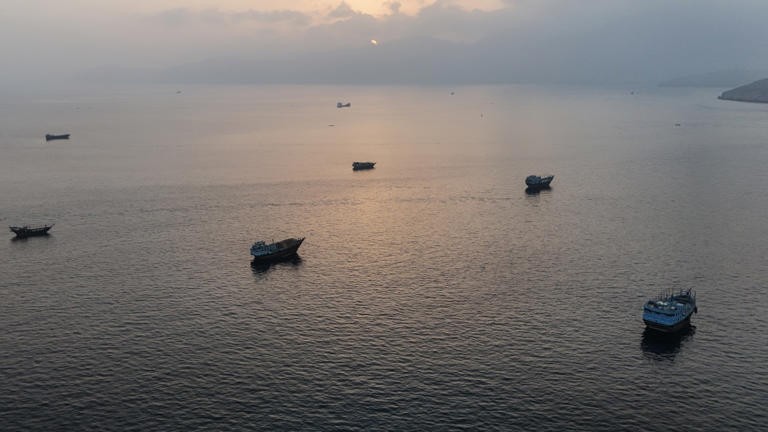
The Kabul Tribune (KT) — The United States and Iran have agreed to end several days of military confrontations around the Strait of Hormuz and resume negotiations aimed at ending the conflict, The Wall Street Journal reported, citing U.S. and other officials involved in the talks.
According to the report, the agreement follows days of
fighting that disrupted efforts by U.S. President Donald Trump to secure a
broader settlement addressing Iran's nuclear program. The clashes also reduced
commercial shipping through the Strait of Hormuz, a vital waterway that
previously carried about 20% of the world's crude oil. A U.S. official told the
newspaper that commercial vessels would now be able to transit the strait
freely.
The Wall Street Journal said Washington has proposed holding
a new round of talks with Iranian officials in Doha, Qatar. While details of
the summit have not been finalized, the meeting could take place as early as July
1, 2026, with discussions expected to focus on restoring stability in the
Strait of Hormuz.
According to the report, U.S.-Iran negotiations that had
been scheduled to resume in Switzerland over the weekend were postponed because
of the fighting. Officials said the two countries had previously agreed to
establish a military hotline to help prevent incidents in the waterway,
although the mechanism has not yet become operational.
Iranian Foreign Minister Abbas Araghchi said on Sunday that
Tehran has sole responsibility for managing maritime traffic through the Strait
of Hormuz, according to Iranian state media. The report noted that his remarks
conflict with the U.S. position that the agreement does not grant Iran control
over navigation in the international waterway.
The Wall Street Journal reported that the latest
confrontation began after Iran attacked a commercial vessel transiting the
strait using a U.S.-backed shipping route near Oman. The United States later
targeted Iranian communications, drone and missile facilities along the Strait
of Hormuz, while Iran subsequently launched attacks against Bahrain and Kuwait.
The report said the preliminary U.S.-Iran agreement postpones
negotiations on more contentious issues, including Iran's nuclear program,
until a second phase of talks.
Meanwhile, U.S. Ambassador to the United Nations Mike Waltz
warned that Washington would not tolerate further attacks on commercial
shipping, saying the United States is prepared to respond if Iran continues
targeting international vessels or U.S. military facilities.
The newspaper also reported that the Joint Maritime
Information Center, operated by the U.S. and U.K. navies, raised its maritime
security threat level in the Strait of Hormuz to "substantial"
following the recent attacks on merchant ships.
The renewed tensions also overshadowed a U.S.-brokered
framework agreement signed between Israel and Lebanon on June 27, 2026.
However, Hezbollah rejected the agreement and vowed to continue fighting
Israel, according to the report.





