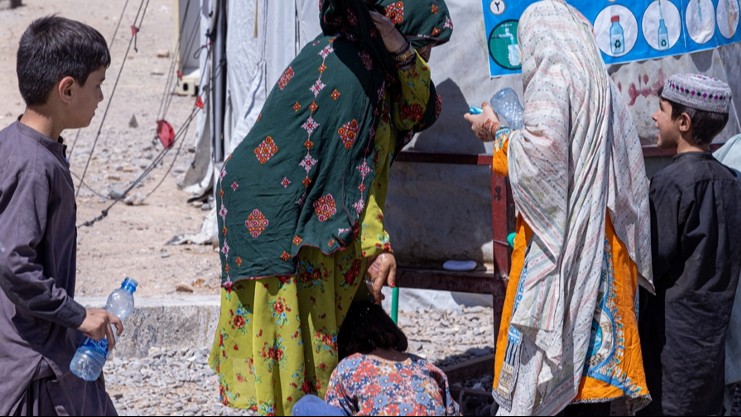
The Kabul Tribune (KT) — A new report by UN Women has warned that Afghan women and girls are facing worsening humanitarian conditions as restrictions imposed by the Taliban, economic hardship, climate disasters and shrinking aid funding continue to deepen vulnerabilities across Afghanistan.
The report, titled 2025 Gender Analysis of Humanitarian
Sectors in Afghanistan, was published in April 2026 by UN Women Afghanistan and
the Afghanistan Gender Coordination Group. It states that nearly 21.9 million
people in Afghanistan — about 45 percent of the population — are expected to
need humanitarian assistance in 2026, including more than 10.7 million women
and girls.
According to the report, Taliban restrictions on women’s
movement, education and employment have severely limited women’s access to
humanitarian assistance, healthcare, livelihoods and public life.
The report said women-headed households are among the
hardest hit, with many led by widows and facing significantly higher levels of
poverty, hunger, displacement and protection risks than male-headed households.
UN Women said repeated climate-related disasters, including
droughts, floods and earthquakes in 2025, combined with the return of nearly
2.8 million Afghans from Iran and Pakistan, have intensified pressure on vulnerable
families across the country.
The report noted that women and girls are increasingly
forced into harmful coping strategies, including child labor, school
withdrawal, begging and early marriage due to worsening economic conditions and
food insecurity. It cited findings showing that 4 percent of women-headed
households reported marrying off daughters earlier than intended because of
financial stress, compared with 1 percent among male-headed households.
Food insecurity remains widespread, with women-headed
households reporting more severe hunger levels than male-headed households.
According to the report, 41 percent of women-headed households said they had no
food at home at some point during the previous month because of a lack of
resources, while 42 percent reported going to sleep hungry.
The report also highlighted major barriers to education for
girls. More than half of school-aged girls in Afghanistan are currently out of
school, largely because of the Taliban ban on education for girls beyond sixth
grade. The study found that 58 percent of school-aged girls are not attending
school, compared with 27 percent of boys.
Healthcare access for women has also sharply deteriorated,
according to the report. It said restrictions affecting female health workers,
the closure of women’s medical training institutes and funding cuts have
weakened Afghanistan’s healthcare system. UN Women cited reports showing that
167 health facilities closed during 2025 alone.
The report further warned that women face growing protection
risks, including community violence, unsafe shelter conditions and limited
access to clean water and sanitation services. Women-headed households were
found to be more vulnerable to eviction threats, overcrowded housing and unsafe
living conditions.
UN Women also raised concerns about shrinking humanitarian
space for women aid workers in Afghanistan. According to the report, Taliban
restrictions on female humanitarian staff continue to reduce women’s access to
life-saving services and weaken accountability mechanisms for women and girls.
The organization called for stronger gender-responsive
humanitarian programs, increased support for women-headed households and urgent
efforts to improve safe access to healthcare, education, livelihoods and humanitarian
assistance for Afghan women and girls.





