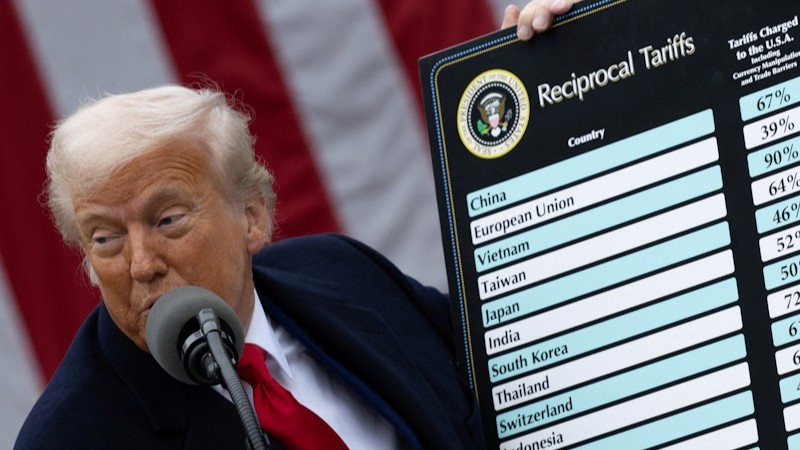
The Kabul Tribune (KT) — Reuters reported that the U.S. Supreme Court struck down sweeping tariffs imposed by former President Donald Trump under a law intended for national emergencies.
In a 6–3 decision authored by Chief Justice John Roberts,
the court upheld a lower court ruling that Trump exceeded his authority by
using the 1977 International Emergency Economic Powers Act (IEEPA) to impose
broad import taxes. The justices ruled that the law did not grant the president
the power to impose tariffs.
“Our task today is to decide only whether the power to
‘regulate … importation,’ as granted to the president in IEEPA, embraces the
power to impose tariffs. It does not,” Roberts wrote in the opinion.
The ruling marks a significant defeat for Trump and has
major implications for the global economy. The three dissenting justices were Clarence
Thomas, Samuel Alito and Brett Kavanaugh.
According to Reuters, Trump criticized the possibility of
the court blocking his tariffs during an event in Georgia, saying, “Without
tariffs ... everybody would be bankrupt. The whole country would be bankrupt.”
After the ruling, he reportedly called the decision a “disgrace.”
Scott Lincicome, an economist at Cato Institute, described
the decision as a relief for American businesses. However, he said the ruling
does not resolve the issue of refunds for tens of billions of dollars in
customs duties that were collected. He warned that the refund process could
involve further litigation and paperwork, posing particular challenges for
smaller importers.
A tariff is a tax imposed on imported goods, typically
calculated as a percentage of the product’s price and paid by the importing
company. In the United States, tariffs are collected by U.S. Customs and Border
Protection at more than 300 ports of entry. While importers pay the tax, the
cost is often passed on to consumers through higher prices.
The British government said it expects its privileged
trading position with the United States to continue despite the ruling, noting
that the United Kingdom enjoys some of the lowest reciprocal tariffs globally.
The case was brought by businesses affected by the tariffs
along with 12 U.S. states, most governed by Democrats. The Supreme Court heard
arguments in November, and Trump previously said he would consider alternative
measures if the court ruled against him.
Analysts said the decision could have broad implications for
presidential powers, financial markets and global trade flows, as tariffs have
been a central tool in Trump’s economic and foreign policy strategy.