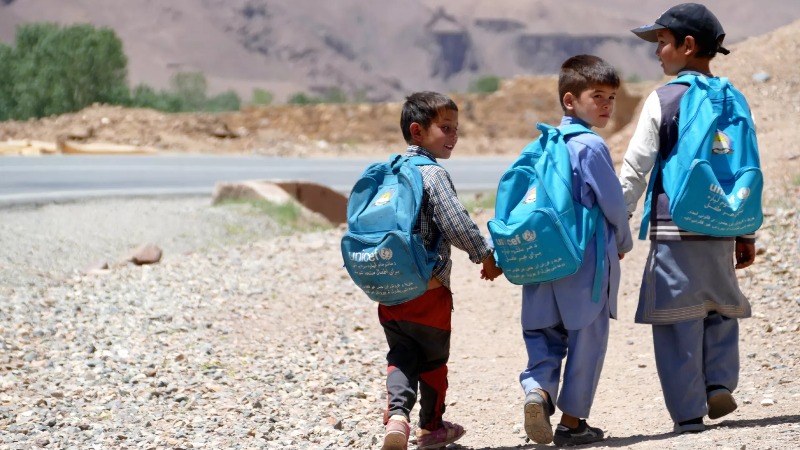
The Kabul Tribune (KT) — Afghanistan’s education system is facing an unprecedented crisis, with millions of children — especially girls — shut out of classrooms and learning outcomes among the worst in the world, according to a new UNICEF report.
UNICEF said two decades of educational progress have been
reversed by restrictive policies, chronic underinvestment and recurring
humanitarian crises. The agency warned that access, quality and equality in
education are rapidly deteriorating.
Early childhood education remains severely underdeveloped,
with less than 1% of children ages 3 to 5 enrolled in early learning. A
2022–2023 survey found only 29% of children in that age group are
developmentally on track. UNICEF’s play-based and parenting pilot programs have
shown promise but remain limited in scale.
Primary school enrollment reached 6.77 million in 2024, but
growth has stalled. Boys’ attendance is increasingly affected by poverty and
work demands, while gains for girls remain fragile and uneven. At the secondary
level, girls are completely excluded beyond Grade 6, according to Education
Management Information System records.
The education sector also faces a severe shortage of
teachers, inadequate facilities and chronic underfunding. Nearly half of
schools lack safe buildings, 79% have no electricity, and many do not have
water, sanitation or boundary walls — conditions that especially discourage
girls from attending.
Learning outcomes are alarmingly low. More than 90% of
10-year-olds cannot read a simple text, UNICEF said, describing Afghanistan as
facing one of the world’s worst learning crises. A nationwide Grade 3
assessment launched with UNESCO aims to gather evidence on learning outcomes
and teaching practices.
Recent curriculum changes have shifted classroom hours from
languages and social sciences to religious and STEM subjects. Under a new plan,
Islamic studies will account for nearly half of weekly teaching hours, creating
a unified curriculum for public schools and madrasas.
Meanwhile, humanitarian needs continue to rise. UNICEF
estimates that 8.9 million children — including nearly 900,000 with
disabilities — will require emergency education support in 2025. The
Humanitarian Response Plan is only 22% funded.
The return of about 2.7 million Afghans from Iran and
Pakistan since 2023, 40% of them children, has added further strain to the
already fragile system. Many girls over age 12 remain unable to enroll due to
infrastructure shortages and bans on their education.
Literacy rates remain among the lowest in the world. Only 27%
of Afghan women can read and write, and female participation in higher
education has collapsed from 27% in 2019 to zero by 2024. Curriculum changes
have also removed subjects such as human rights, gender equality and political
science, raising concerns about academic freedom.
Despite the challenges, UNICEF said opportunities still
exist. Expanding safe and inclusive schools, supporting teachers, and linking
skills training to market demand could help bridge humanitarian needs with
long-term recovery.
“Coordinated and sustained action is essential to ensure
every Afghan child has the opportunity to learn, grow and contribute to the
country’s future,” the agency said.





