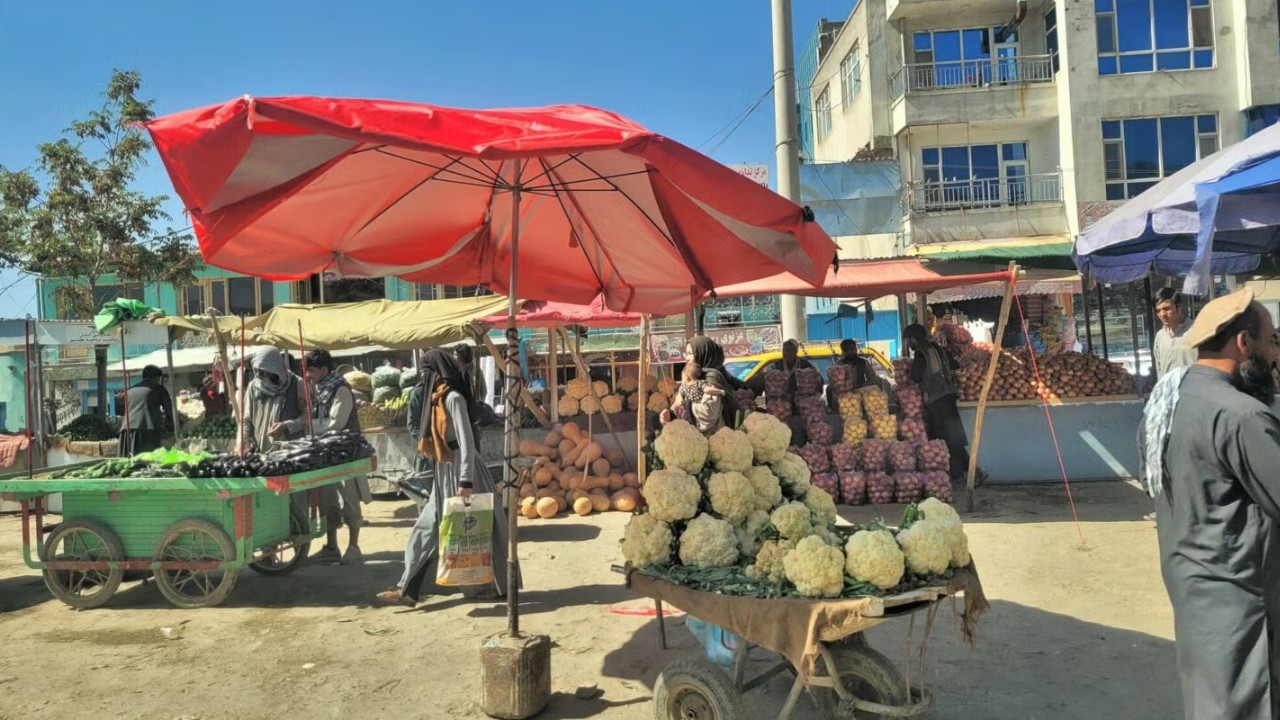
The Kabul Tribune (KT)— Consumer prices in Afghanistan rose 6.4% in October compared with the same month last year, while monthly inflation edged up 0.1%, according to a report by Data for Afghanistan, an initiative aimed at expanding access to data on the country.
The report found that food prices fell 0.2 percentage points
in October, while non-food prices added 0.3 percentage points to the overall
monthly change.
Health costs recorded the steepest annual increase, rising
16.4%, while housing costs increased 7.4%. Prices of spices saw the largest
annual decline, falling 12.1%, the report said.
Price changes varied significantly across provinces. Kabul
recorded the highest monthly inflation rate at 0.6%, while Takhar had the
largest monthly decline, at 1.6%. Eleven of the 20 provinces covered reported a
monthly decrease in food prices, while nine recorded food inflation above the
national average of minus 0.3%.
Sar-e-Pul faced the highest annual cost-of-living increase,
at 21.6%, while Parwan recorded the lowest annual rate, at minus 3.9%.
The report also highlighted pressure on households' ability
to afford basic food. The national median flour purchasing power stood at 9.4
kilograms of low-quality wheat flour for a day's unskilled wage. Workers in 17
provinces could afford less than that amount, with Ghor recording the lowest
purchasing power at 6.1 kilograms per day. Nimroz had the highest rate, at 15.5
kilograms.
National median prices for basic food commodities included
32.7 Afghanis per kilogram for high-quality wheat flour and 30.2 Afghanis for
low-quality flour. High-quality rice cost 122.3 Afghanis per kilogram, while
low-quality rice was priced at 70 Afghanis. Pulses cost 81.9 Afghanis, sugar
57.5 Afghanis, cooking oil 121.1 Afghanis and salt 23 Afghanis per kilogram.
Food insecurity also remained widespread. The report found
that at least 40% of the food-insecure population in 18 provinces faced
Crisis-level food insecurity or worse, classified as Integrated Food Security
Phase Classification (IPC) Phase 3 or above.
The provinces were Badakhshan, Badghis, Baghlan, Balkh,
Bamyan, Daykundi, Faryab, Ghazni, Ghor, Jawzjan, Kunar, Laghman, Nangarhar,
Nuristan, Paktika, Samangan, Sar-e-Pul and Takhar.
The report's findings show that while overall monthly
inflation remained limited in October, rising health and housing costs,
differences in provincial prices and limited purchasing power continued to
place pressure on households across Afghanistan.