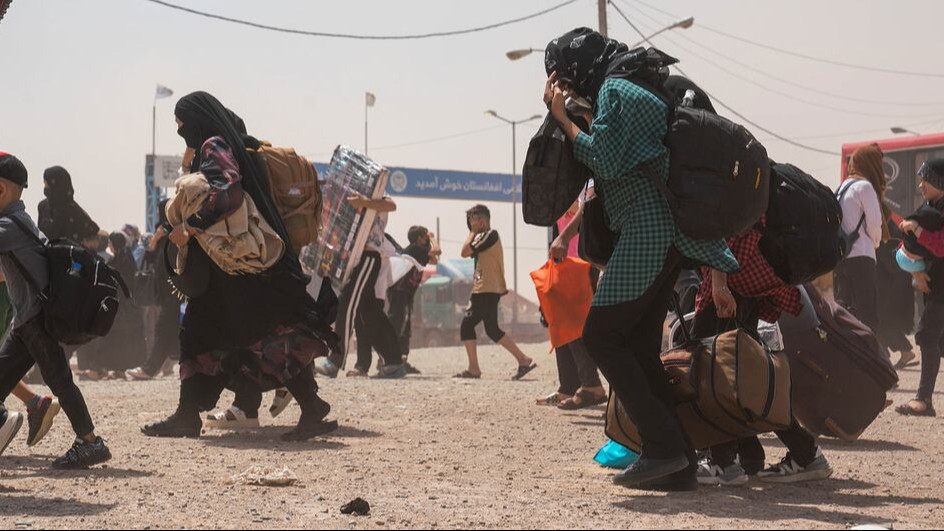
The Kabul Tribune (KT)-- After losing jobs, income and relative stability in Iran, Afghan women who have been forced to return are facing unemployment, poverty and limited opportunities at home, while aid agencies say millions of returnees need support.
Zahra had a job and an income in Iran. Now, despite having
completed midwifery training, she cannot find work in Afghanistan and sees her
son only twice a month.
“Sometimes I can’t see him,” she said. “I only see him twice
a month.”
She is among millions of Afghans who have returned from Iran
and Pakistan in recent years following large-scale deportations. Many women
have come back after leaving behind employment and a degree of economic
stability, only to face hardship and few opportunities to rebuild their lives.
Homa, 44, is another returnee struggling to support her
family. After spending six years in Iran, she now lives with her husband, who
has a disability and cannot work, in a single room at her brother-in-law’s
house. She earns money by cleaning homes and sewing clothes when she can find
customers.
“I had a better life in Iran,” she said. “Unfortunately, we
were deported.”
The financial pressure has become so severe that she
sometimes has to ask strangers for money.
“Some days,” she said, “I must beg in the street.”
Return to a country with fewer opportunities
Zahra left Afghanistan after completing her midwifery
training. She said the Taliban's return to power, the struggling economy and
the fact that she was an educated woman contributed to her decision to leave.
In Iran, she managed to find steady work despite
difficulties in her marriage. Her husband was addicted to drugs, but she had an
income and could support herself.
“I had income,” she said. “I had a better life.”
Homa also managed to earn a living in Iran, cleaning
apartments and collecting recyclable plastic for sale. She said the income
allowed her family to live in a good apartment building, where neighbours
sometimes helped them with food and other necessities.
Since returning to Afghanistan, however, both women have
struggled to meet their basic needs.
Zahra’s father is blind and unable to work, while her
younger brother is the family’s only steady earner. Although she has
professional qualifications and has volunteered at clinics, she has not been
able to secure a job.
“I don’t have opportunities to work,” she said.
Homa, meanwhile, is recovering from surgery for appendicitis
and continues to experience considerable pain. She says she has no support for
her medical needs and had to borrow money from her brother-in-law to pay for
the operation.
“I have no support for my medical needs,” she said.
Millions of returnees need assistance
The scale of returns has added pressure to Afghanistan’s
already strained housing, employment and public services.
Charlie Goodlake of the United Nations High Commissioner for
Refugees (UNHCR) said more than 6.5 million Afghans had returned to the country
over the past three years, including nearly 3 million in 2025 alone. The
returns have added more than 10 percent to Afghanistan’s population.
Women and girls account for more than half of the people
assisted by UNHCR, while women and children together make up nearly 82 percent,
Goodlake said.
“The primary needs of women and girls are, of course,
immediate shelter or a place to live inside Afghanistan,” he said, adding that
cash assistance, education, livelihood opportunities and protection services
are also critical, particularly because of restrictions affecting women and
girls.
Many returnees arrive with few possessions and depend on
relatives or host communities while trying to establish themselves again.
Cash assistance helps women earn an income
UNHCR and its partner organizations have provided support to
both Zahra and Homa as they try to rebuild their lives.
After being referred to a UNHCR partner organization, Zahra
became eligible for cash assistance, legal support and mental health and
psychosocial services.
Homa used her cash assistance to buy a sewing machine,
giving her a way to earn money from home while recovering from surgery.
“When I received the cash assistance, I was able to buy a
sewing machine,” she said. “Now I have an income, and I help my family.”
The assistance also enabled her to buy food for her family,
which had gone without basic supplies.
“I bought rice and oil for my family because two months ago
my family didn’t have any food to eat,” she said.
Goodlake said UNHCR's assistance is intended to address
immediate needs while helping women develop longer-term livelihoods. The agency
runs more than 150 vocational training projects across Afghanistan and
continues to seek ways to help women earn an income despite the restrictions
and other obstacles they face.
Uncertainty over the future
Despite the assistance, both women remain uncertain about
what lies ahead.
Homa says she needs a place to live, food for the winter and
greater stability.
“I also need more food and oil and other things for the
winter,” she said.
Zahra wants to find work, become financially independent and
spend more time with her son. But she does not expect to gain custody of him.
She says her former husband is addicted to drugs and believes the courts would
not support her claim.
“The courts in Afghanistan always side with men,” she said.
For Homa, the uncertainty remains a constant concern.
“I am very worried about the future in Afghanistan,” she
said.