The Kabul Tribune (KT)—Pakistan’s army chief, Field Marshal Asim Munir, reaffirmed the military’s commitment to eliminating terrorism and maintaining security in the northwestern province of Khyber Pakhtunkhwa during a visit to North Waziristan, the military said Friday.
Munir made the remarks in Miranshah, the district’s main
town, where he reviewed the security situation and ongoing counterterrorism
operations, according to a statement by the military’s media wing,
Inter-Services Public Relations.
He said security forces, working closely with law
enforcement agencies, remained determined to eliminate terrorism and preserve
peace and stability in the province.
Munir also praised Khyber Pakhtunkhwa’s police force for its
resilience and sacrifices in fighting militancy. The military statement said he
expressed pride in the force’s efforts against what it called “Fitna
al-Khawarij,” a term the Pakistani state uses for the banned Tehreek-e-Taliban
Pakistan.
During the visit, Munir received a briefing on the security
situation, intelligence-based operations and measures to consolidate gains from
counterterrorism efforts. He also met officers and troops and praised their
preparedness, professionalism and commitment to national security.
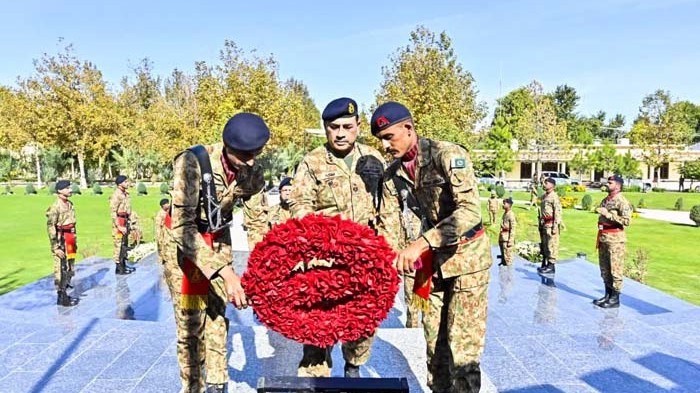
He was received by the Peshawar Corps commander upon arrival
in Miranshah and later laid a wreath at the Yadgar-i-Shuhada memorial in
tribute to fallen Pakistani soldiers, the statement said.
The visit came a day after Munir traveled to Turbat in
southwestern Balochistan province, where he was briefed on the security
situation, operational readiness and ongoing operations against what the
military described as externally sponsored terrorism.
Security forces have continued operations in Khyber
Pakhtunkhwa and Balochistan, two provinces that have been particularly affected
by militancy. The military said Saturday that four soldiers, including a major,
were killed and 24 militants died in intelligence-based operations in
Balochistan and North Waziristan. Last week, the military reported that 74
militants had been killed in operations in the two provinces.
Meanwhile, an Islamabad-based independent think tank, the
Pakistan Institute for Conflict and Security Studies, reported a decline in
militant violence across the country in October compared with September.
According to its monthly assessment, attacks nationwide fell
by 37%, deaths resulting from the attacks declined by 57% and injuries dropped
by 71%.
The report said the reductions were particularly pronounced
in Balochistan and the settled districts of Khyber Pakhtunkhwa.
In Balochistan, attacks fell from 132 in September to 71 in
October, a decline of 46%. Deaths dropped from 136 to 44, while injuries
decreased from 63 to 37.
In the settled districts of Khyber Pakhtunkhwa, the think
tank recorded 40 attacks in October, compared with 58 in September. Deaths fell
from 90 to 38, while injuries declined from 165 to 19.
The report also recorded 30 attacks in the province’s former
tribal districts in October, down from 34 the previous month. Deaths declined
from 33 to 25, while injuries increased from 11 to 13.
In October, Pakistan’s federal government also imposed
emergency measures and governor’s rule in Khyber Pakhtunkhwa, citing what it
described as the provincial government’s deliberate disengagement from the fight
against terrorism.