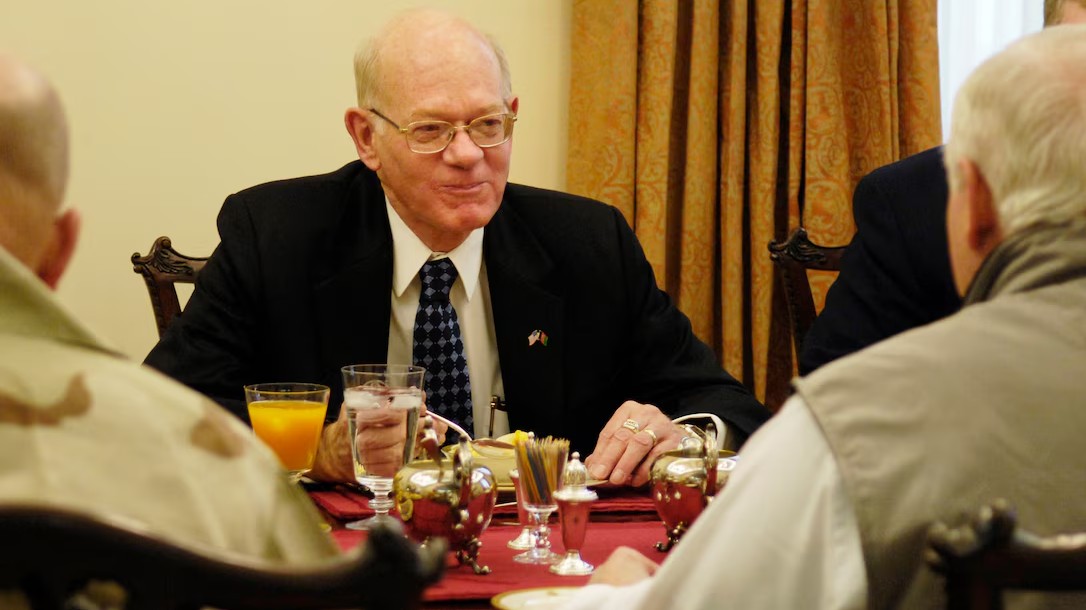
The Kabul Tribune (KT) — Former U.S. Ambassador to Afghanistan Ronald Neumann says he could envision Washington reopening its embassy in Kabul under Taliban rule, but only if the Taliban makes concrete changes to its policies.
Neumann, who served as U.S. ambassador to Afghanistan from 2005 to 2007, made the comments in an interview with i24NEWS. He said there are practical reasons for the United States to maintain engagement with the Taliban despite deep disagreements over the group’s policies.
Asked whether the U.S. flag could again fly over the embassy in Kabul, Neumann said he could imagine such a scenario.
But he said the Taliban would need to change some of its policies, particularly its treatment of women and girls, which he said could trigger strong political opposition in the United States to reopening the embassy.
“I think the Taliban would have to make some policy changes,” Neumann said, adding that the domestic political reaction in the United States to ignoring the restrictions imposed on women would be significant.
The United States closed its embassy in Kabul and suspended diplomatic operations there in August 2021, as U.S. forces withdrew from Afghanistan and the former Afghan government collapsed. Washington has not formally recognized the Taliban government.
Neumann said the Taliban had sought to maintain political ties with the United States during negotiations in Doha before returning to power.
He said Washington is already engaging with the Taliban on a pragmatic basis in areas where the interests of both sides overlap, including efforts to secure the release of Americans detained in Afghanistan and counterterrorism cooperation.
But Neumann said the Taliban’s policies toward women and girls remain a major obstacle to closer relations. He argued that the group has not moderated its approach since returning to power and has instead imposed further restrictions on women.
Neumann also warned that completely disengaging from Afghanistan could create risks for the United States. He pointed to previous periods when Washington reduced its involvement in Afghanistan and said the consequences had eventually affected U.S. interests.
His comments come as several regional countries have expanded their engagement with the Taliban. Russia has formally recognized the Taliban government, while China and several of Afghanistan’s neighbors have developed political and economic ties with Kabul.
Neumann said Afghanistan’s mineral resources could eventually provide another incentive for greater U.S. engagement, but cautioned that significant investment remains years away.
He said large-scale development of Afghanistan’s mineral resources would require sustained security, investment and stronger rule of law to give companies confidence that their investments would be protected.
“None of that exists now,” Neumann said, adding that the conditions could theoretically be created but that major investment was not yet a serious prospect.
Reflecting on the U.S. involvement in Afghanistan over the past two decades, Neumann said Washington initially provided too little economic assistance and later committed billions of dollars faster than Afghan institutions could effectively absorb.
He recalled requesting $600 million in additional economic assistance while serving as ambassador but receiving $43 million because U.S. resources were heavily focused on Iraq.
Neumann said Washington later spent billions of dollars in an effort to achieve rapid stabilization in Afghanistan, but much of the money was concentrated in limited areas.
“The Afghan political system could not absorb that money,” he said, arguing that weak institutional capacity contributed to corruption.
Neumann said any future rapprochement between Washington and the Taliban should be gradual and based on reciprocal actions, with U.S. concessions tied to concrete steps by the Taliban.
“You should only trade real actions for real actions,” he said.
If reopening the U.S. Embassy is something the Taliban wants and Washington concludes that doing so serves U.S. interests, Neumann said the United States should seek a specific concession in return rather than rely on promises of future changes.
He said trust between the two sides remains limited and warned that reopening the embassy without securing a reciprocal commitment could reduce the Taliban’s incentive to change its policies.
The U.S. Embassy in Kabul has remained closed since August 2021, with American diplomatic activities related to Afghanistan conducted from outside the country.