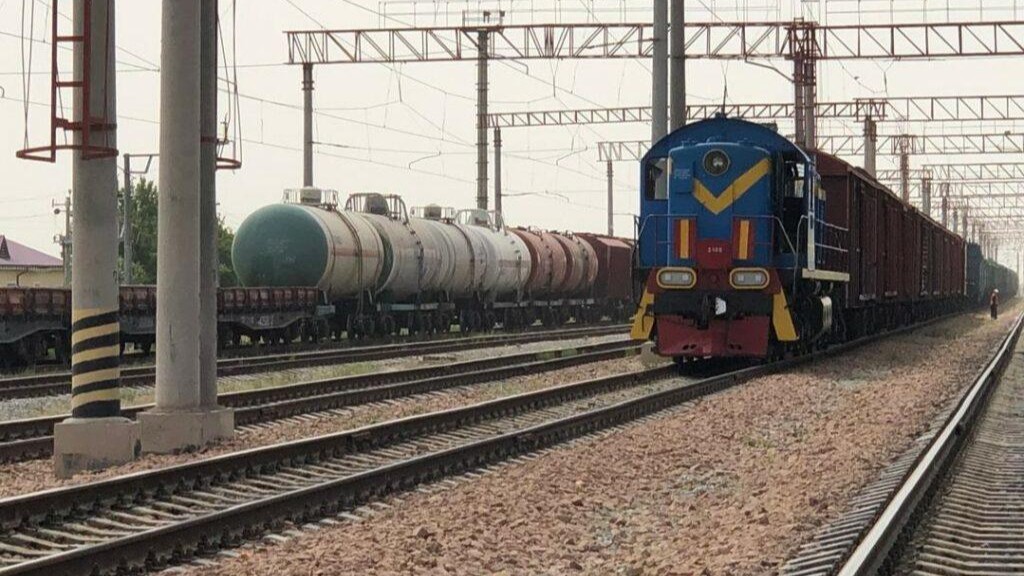
The Kabul Tribune (KT) — Russia needs to explore establishing a railway route to the Indian Ocean to reduce risks associated with the Bosphorus and Strait of Hormuz, Russian Deputy Prime Minister Marat Khusnullin said in an interview with TASS.
“A rail link to the Indian Ocean should also be explored,”
Khusnullin said, according to TASS. He said risks linked to the Bosphorus and
Strait of Hormuz could require alternative transportation routes through Turkmenistan,
Iran, Afghanistan and Pakistan.
“Any options providing access to India are acceptable,” he
said, emphasizing that Moscow could consider any route that would secure access
to India.
Khusnullin also highlighted the financing needs of Russia’s
construction industry. He said the sector is currently seeking long-term
financing and has the capacity to handle an additional 1 trillion rubles ($12.5
billion) in annual construction activity.
“The construction industry is already capable of handling an
additional one trillion rubles annually,” Khusnullin said. He added that if
such financing were secured for the next five years, the industry could expand
its capacity further and undertake even more construction projects.
His comments come amid disruptions to shipping through the
Strait of Hormuz following the outbreak of the conflict between the United
States and Iran. According to TASS, the United States and Israel launched
attacks on Iran on Feb. 28, with major Iranian cities, including Tehran, coming
under attack.
The Islamic Revolutionary Guard Corps, an elite branch of
Iran’s armed forces, subsequently announced a large-scale retaliatory operation
targeting Israel and U.S. military facilities in Bahrain, Jordan, Iraq, Qatar,
Kuwait, the United Arab Emirates and Saudi Arabia, TASS reported.
Iranian authorities have also decided to block vessels
linked to the United States, Israel and countries that supported what Tehran
described as aggression against Iran from using the Strait of Hormuz.
The strategic waterway is one of the world’s most important
energy corridors, with roughly 25% of global oil trade and about 20% of
liquefied natural gas shipments passing through it, according to TASS.
The proposed railway route would potentially create an
overland connection between Russia and the Indian Ocean while providing an
alternative to maritime routes vulnerable to disruptions at major strategic
chokepoints.





