The Kabul Tribune (KT) — The United Nations says Afghanistan is facing worsening humanitarian conditions, widespread human rights violations and growing economic pressures while the Taliban remain firmly in control of the country, according to the latest quarterly report by U.N. Secretary-General António Guterres to the Security Council.
The report, covering the period from Nov. 1, 2025, to Jan.
31, 2026, states that Taliban authorities maintained effective control over
Afghanistan while continuing to enforce policies based on their interpretation
of an Islamic system that restricts the rights of women and girls.
According to the report, Taliban authorities continue to
prevent Afghan women employed by the United Nations from accessing U.N. offices
in the country, a restriction that has affected the organization’s ability to
fully carry out its mission.
The report also documents widespread human rights concerns,
including corporal punishment, public executions, arbitrary arrests and
restrictions on freedom of expression and the media.
During the reporting period, the United Nations recorded 316
cases of corporal punishment carried out by Taliban authorities. It also
documented 12 extrajudicial killings, 29 arbitrary arrests and detentions, and
six cases of torture or ill-treatment involving former government officials and
members of the former Afghan security forces.
In addition, on Dec. 2, 2025, Taliban authorities publicly
executed a man convicted of murder in a sports stadium in Khost province,
marking the twelfth publicly carried out execution in Afghanistan since the
Taliban returned to power in 2021.
Security incidents across the country have also increased.
The United Nations recorded 2,660 safety and security-related incidents between
November 2025 and January 2026, representing a 27.8 percent increase compared
with the same period the previous year.
Armed opposition groups carried out several attacks against
Taliban forces during the reporting period. However, the report says these
groups did not pose a significant challenge to Taliban control over the
country.
The Islamic State’s regional branch, known as ISIS-K,
continues to pose a serious security threat. On Jan. 19, 2026, a suicide
bombing at a Chinese restaurant in Kabul killed seven people and injured 13 others,
with ISIS-K claiming responsibility for the attack.
The report also highlights continued cross-border tensions
between Afghanistan and Pakistan. According to the United Nations, clashes
between Taliban and Pakistani security forces caused at least 50 civilian
casualties — including 24 killed and 26 injured — mainly due to airstrikes and
cross-border shelling in several eastern and southern provinces.
Meanwhile, Afghanistan’s humanitarian and economic situation
continues to deteriorate amid declining international assistance, natural
disasters and the return of millions of Afghans from neighboring countries.
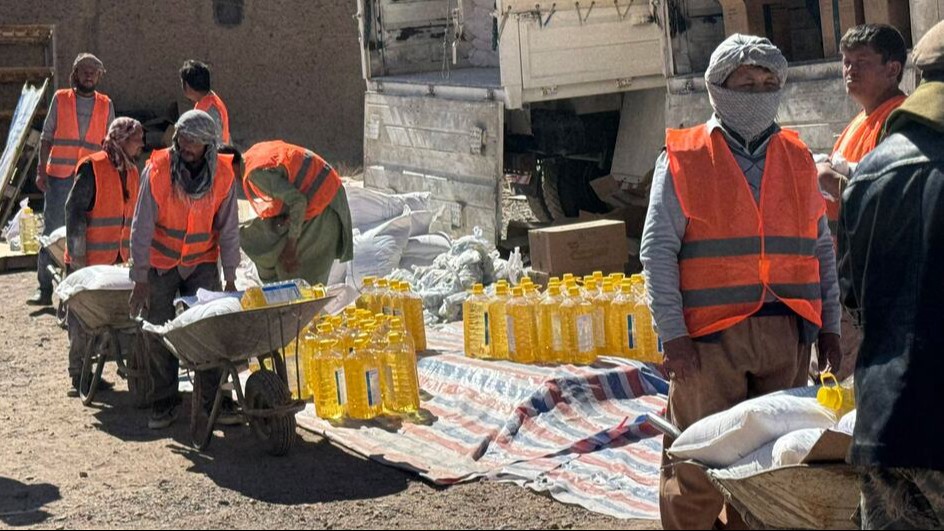
The United Nations estimates that 21.9 million people —
nearly half of Afghanistan’s population — will require humanitarian assistance
in 2026. The 2026 Humanitarian Needs and Response Plan is seeking $1.71 billion
to provide life-saving assistance to 17.5 million people.
Food insecurity remains a major concern. According to the
report, about 17.4 million people are facing acute food insecurity, including 4.7
million people experiencing emergency-level hunger.
The country is also facing a severe child malnutrition
crisis. An estimated 3.7 million children under the age of five and 1.2 million
pregnant and breastfeeding women are suffering from acute malnutrition.
Funding shortages have also forced the closure of hundreds
of health and nutrition facilities across the country, leaving millions without
access to basic services.
The report further notes that the ban on secondary education
for girls has now affected about 2.2 million girls, while women continue to
face severe restrictions on education, employment and public participation.
Secretary-General António Guterres warned that the continued
restrictions on women and girls, along with declining international aid,
climate-related disasters and economic challenges, are increasing pressure on
the Afghan population.
He urged Taliban authorities to lift restrictions on women
and girls, particularly the ban on secondary education, and to allow Afghan
female U.N. employees to return to their workplaces.
The report also called on all parties involved in
cross-border tensions to protect civilians and resolve disputes through
diplomatic means.





