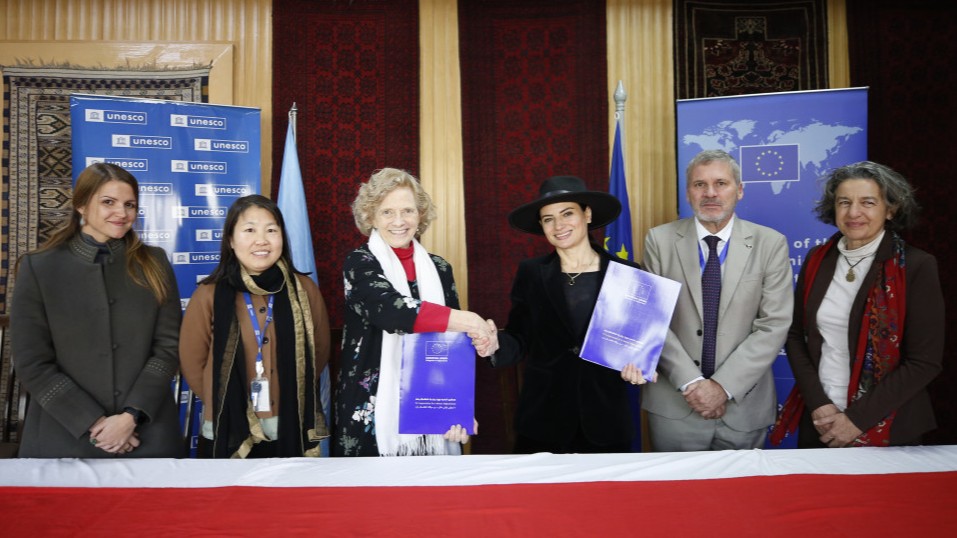
The Kabul Tribune (KT) — The European Union has announced a new €4.7 million partnership with UNESCO aimed at expanding community-based literacy programs and economic empowerment initiatives across Afghanistan, the EU said in a statement.
The initiative will provide education and livelihood skills
training to 7,500 youths and adults — including returnees and host community
members — across five provinces. The program integrates basic literacy and
numeracy education, equivalent to a Grade 3 level, with vocational skills
aligned with local economic needs.
According to the EU, the approach is community-driven,
flexible and based on the “do-no-harm” principle, addressing needs identified
directly by local communities.
“The EU has decided to allocate a new significant financial
allocation to support communities with concrete tools that contribute to
livelihoods and local economic empowerment,” said Veronika Boskovic Pohar, the
EU’s Chargé d’Affaires. “By investing in learning and skills, we aim to help
Afghan people and families build their well-being. We stand with the people of
Afghanistan.”
Training will focus on locally relevant home-based income
skills such as tailoring, dairy production, poultry farming and small-scale
agriculture — areas shown to improve household earnings in targeted
communities. UNESCO says its literacy and vocational programs have reached more
than 56,000 learners since 2023.
“Building on UNESCO’s long-standing work in literacy and
livelihood skills training in Afghanistan, this initiative offers communities
practical tools to address daily challenges,” said Patricia McPhillips, UNESCO
representative. “We are pleased to join efforts with the European Union to
expand access to education and skills development opportunities that support
self-reliance and contribute to community resilience and economic empowerment.”





