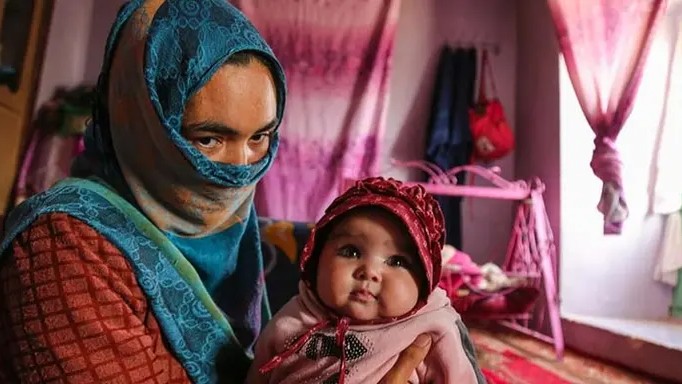
The Kabul Tribune (KT) — Armed conflict, economic hardship, climate shocks and cuts to international aid are putting more girls at risk of child marriage as families struggle with mounting pressures, Save the Children warned Friday.
The international children’s rights organization said global
efforts to eliminate child marriage by 2030 were falling significantly behind
schedule, with progress slowing in recent years.
The warning was issued on Nov. 27 to mark the first
International Day for the Elimination of Child, Early and Forced Marriage.
An estimated 12 million girls worldwide are married before
the age of 18 each year, equivalent to about 23 girls every minute, or nearly
one every three seconds, according to Save the Children.
The organization said the global prevalence of child
marriage had declined by just 3.4 percentage points since 2014, falling from
21.9% to 18.5%. Progress has almost stalled over the past two years, putting
the international goal of ending the practice by 2030 at risk.
Conflict-affected areas face particularly serious
challenges. Citing United Nations data, Save the Children said reported cases
of child and forced marriage in Gaza increased by 123% between the first and
second quarters of 2026. Girls aged 12 to 17 accounted for 16% of reported
cases.
Despite the slow global progress, the organization pointed
to Bangladesh and Sierra Leone as examples of countries where sustained efforts
have helped protect girls.
In Bangladesh, investment in girls’ education and social
protection, alongside measures to prevent gender-based violence and promote
girls’ rights, helped reduce the proportion of young women married before age
18 from 62.7% to 47.2%.
Sierra Leone strengthened legal protections in 2024 by
adopting legislation banning child marriage.
Rahinatu Adamu Hussaini, a Save the Children specialist in
gender-based violence prevention and response, said child marriage was a form
of gender-based violence that violated girls’ rights to education, health and
personal autonomy and exposed them to lifelong inequality.
The organization called on governments, donors and
international institutions to increase funding for programs supporting
vulnerable families, expanding girls’ access to education and protecting them
from violence.
The U.N. General Assembly designated Nov. 27 as the
International Day for the Elimination of Child, Early and Forced Marriage in a
resolution adopted on Sept. 4, 2026. The United Nations has warned that the
current rate of decline in child marriage is insufficient to meet the 2030
Sustainable Development Goal target of ending the practice.
In Afghanistan, 28.7% of women aged 20 to 24 were married
before turning 18, according to the 2022-2023 Multiple Indicator Cluster Survey
cited by UNICEF. In some parts of the country, the proportion reached one in
two.
The Taliban’s ban on girls’ education beyond sixth grade and
restrictions on women’s rights have further heightened concerns about child and
forced marriage in Afghanistan.
UNICEF has repeatedly warned that keeping girls out of
school increases their vulnerability to early marriage, exploitation and
gender-based violence, while limiting their future economic opportunities and
independence.