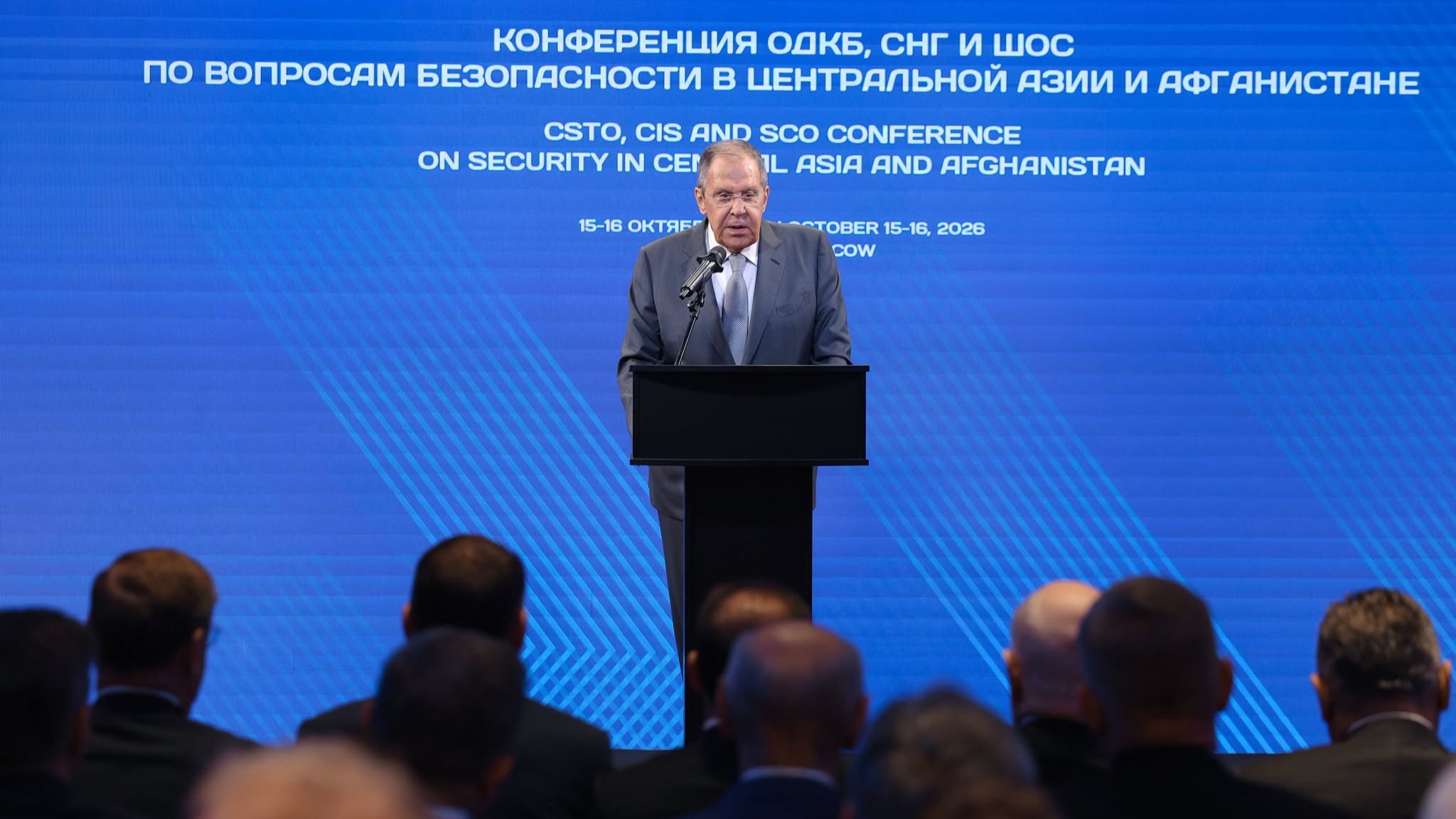
The Kabul Tribune (KT) — Russian Foreign Minister Sergey Lavrov warned Friday that the Islamic State group’s regional branch seeks to undermine the Taliban authorities and expand its operations into Central Asia and Russia, calling for greater regional cooperation to counter the threat.
Speaking at a security conference in Moscow attended by representatives
of the Collective Security Treaty Organization, the Commonwealth of Independent
States and the Shanghai Cooperation Organization, Lavrov said militant groups
maintained training camps and strongholds in Afghan border areas near
Tajikistan, Turkmenistan and Uzbekistan.
Lavrov said militants were seeking to enter Central Asian
countries, sometimes posing as refugees or tourists. He also warned of attempts
to smuggle weapons and drugs through the region into Russia.
The Russian foreign minister identified the Islamic State
Khorasan Province, the group’s regional affiliate, as a major security concern
and said it sought to use Afghanistan as a base for expanding its activities
beyond the country.
The claims were made by Lavrov at the conference and were
not independently verified.
Despite his warnings, Lavrov defended Moscow’s engagement
with the Taliban authorities, arguing that cooperation with them was necessary
to address regional security challenges.
“We proceed from the premise that the government — the
Taliban movement — is a reality that must be reckoned with,” Lavrov said,
adding that an increasing number of countries were recognizing the need to
engage with the authorities in Kabul.
Russia has expanded its ties with the Taliban since the group
returned to power in 2021. Moscow formally recognized the Taliban government in
2025, becoming the first country to do so.
Lavrov said Russia supported integrating Afghanistan into
regional economic frameworks and providing economic and humanitarian assistance,
arguing that regional engagement could complement efforts to improve security.
He also called for stronger intelligence-sharing and
coordination among Russia and its Central Asian partners to counter terrorism
and narcotics trafficking.
Lavrov used the conference to criticize NATO’s expanding
security role, arguing that Eurasian countries should develop their own
regional security framework rather than rely on outside military alliances.
“NATO is not about Eurasia,” he said, reiterating Russia’s
support for a Greater Eurasian Partnership and a continental security framework
involving regional countries and multilateral organizations.
The remarks underscore Moscow’s efforts to strengthen
regional security cooperation while maintaining political and economic
engagement with the Taliban authorities, even as Russian officials continue to
warn about threats posed by militant groups operating in and around
Afghanistan.




