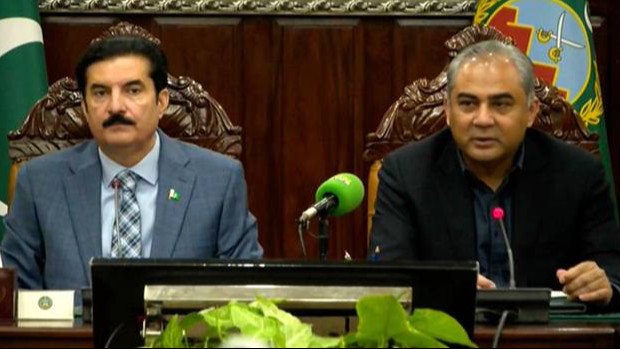
The Kabul Tribune (KT) — Khyber Pakhtunkhwa Governor Faisal Karim Kundi on Monday pledged closer coordination with Pakistan’s federal government and criticized the province’s previous Pakistan Tehreek-e-Insaf (PTI)-led administration, saying the new provincial setup would take its policy direction from Islamabad rather than Kabul.
“Gone are the days when there was no coordination between
the Centre and the province. We will have coordination with the Centre; our
policies will come from Islamabad, not Kabul, Jalalabad or Kandahar,” Kundi
said at a news conference in Peshawar, according to Pakistani media--The Nation.
His remarks came a day after Pakistan’s federal government
imposed governor’s rule in the northwestern province and transferred executive
authority to Kundi, following tensions with the previous provincial
administration over security policy and counterterrorism efforts. The PTI has
opposed the federal government’s actions and has disputed its handling of the
security situation.
Kundi’s reference to Kabul was part of his criticism of the previous
administration and its approach to counterterrorism. It did not establish that
Afghanistan’s Taliban authorities had control over the province’s policy
decisions.
At a meeting of the Provincial Apex Committee chaired by
Kundi on Monday, officials reviewed the security situation and called for
coordinated action by relevant departments to combat terrorism and restore
lasting peace.
The committee paid tribute to security personnel killed in
the line of duty and called for greater attention to education, health care and
living standards, particularly in underdeveloped areas affected by violence.
Kundi said counterterrorism was the new administration’s top
priority and that the federal government had assured the province it would meet
funding shortfalls for police and security forces.
He said the 11-member advisory council appointed under
governor’s rule had assumed responsibility for its assigned departments. The
administration would work to improve police salaries, increase compensation for
families of personnel killed in the line of duty and provide free education to
their children, he said.
The governor also pledged to resume stalled projects
involving police lines, stations, checkpoints and Safe City initiatives. He
promised zero tolerance for corruption and said previous recruitment processes
would be scrutinized.
The apex committee decided to strengthen the provincial
police and the Counter-Terrorism Department by providing modern equipment,
logistical support and additional personnel. Intelligence-based operations
against militants would continue, it said.
Kundi warned that vandalism, disorder and violations of the
law would not be tolerated. He also said the administration would seek to
attract investment, create jobs and address public grievances.
He expressed confidence that the new administration would
demonstrate tangible progress within three months, contrasting its plans with
what he described as the previous 13 years of provincial rule under the PTI.
Kundi also said threats had been made against the Governor
House following recent protests and that authorities had made the necessary
security arrangements. He claimed that the public had rejected what he called a
politics of chaos.
Separately, Pakistan’s Interior Minister Mohsin Naqvi said
the federal government had handed over 10 newly acquired armored personnel
carriers to Khyber Pakhtunkhwa Police on the instructions of Prime Minister
Shehbaz Sharif.
In a post on X, Naqvi said the transfer was intended to
support counterterrorism operations amid rising militant attacks in the
province. He described the fight against terrorism as a shared responsibility
and pledged continued federal support for provincial police.
Meanwhile, Pakistan’s Ministry of Information and
Broadcasting accused social media accounts of circulating misleading material
to create an impression of unrest in Khyber Pakhtunkhwa.
In a post on X, the ministry’s fact-checking unit said the
material included artificial intelligence-generated visuals, old footage and
unrelated videos, including images of factory fires, protests over electricity
outages and events in Syria.
The ministry also alleged that Afghan and Indian accounts
were amplifying the material alongside political accounts. It did not provide
further details in the statement about the accounts involved or the evidence
supporting the allegation.