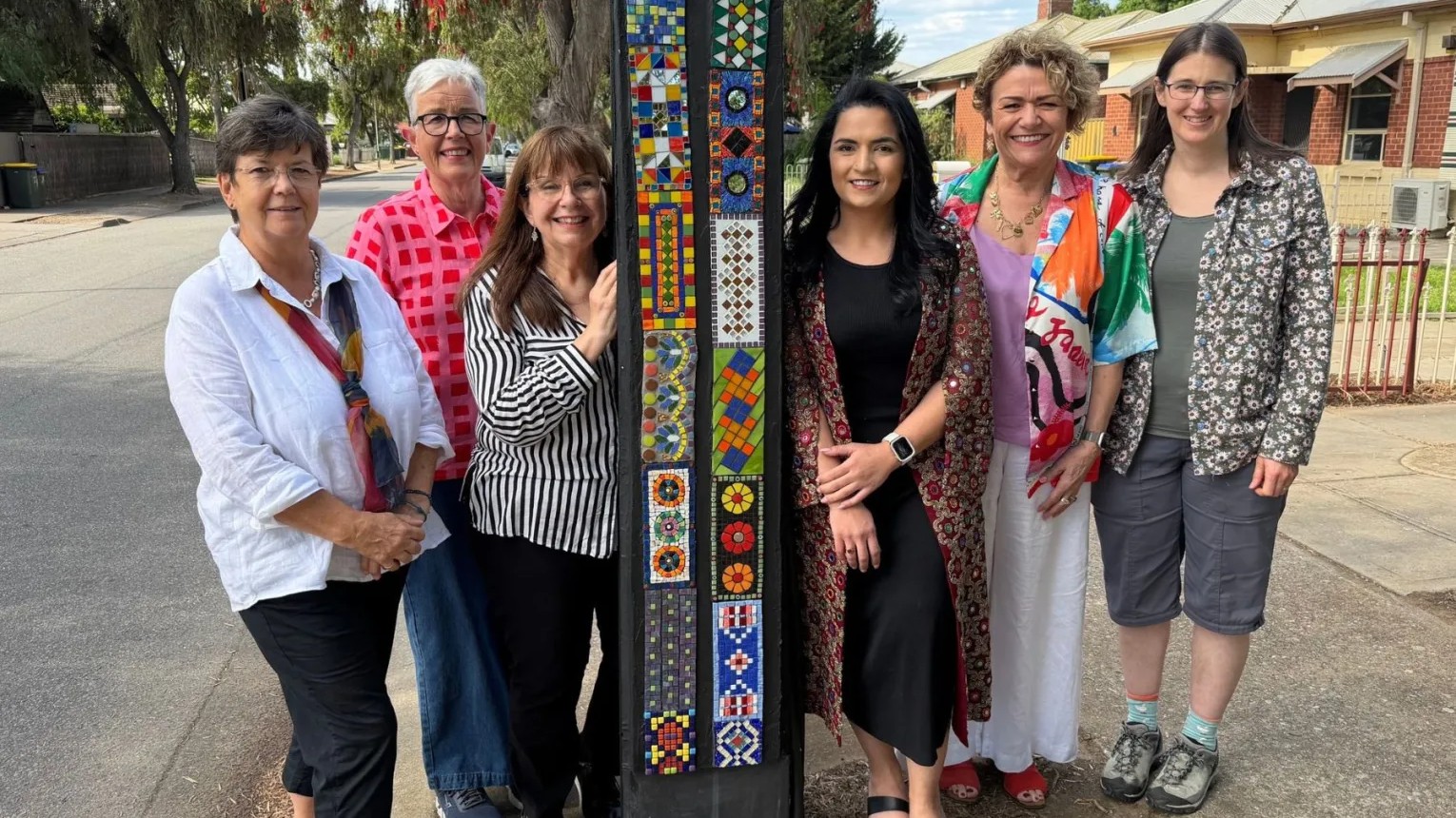
A new permanent Adelaide art installation is ensuring the plight of women and girls struggling with an oppressive regime in Afghanistan is not forgotten. One woman tells why it’s deeply personal.
A striking mosaic mural inspired by Afghan dress and
embroidery is bringing a message of solidarity to Adelaide’s inner north-west.
The new South Australian installation, Hanging by a Thread, was
unveiled on Blight Street, Ridleyton, on Friday linking local artists to a
worldwide arts movement.
To date, more than 1200 mosaic artists from 46 countries
have contributed segments to the international project that draws inspiration
from traditional clothing, embroidery and cultural motifs. This piece involved
120 local community members including mosaic artists.
For Afghan Women Federation of SA President Behishta Anwar,
the project is deeply personal.
Anwar arrived in Australia as a refugee in 2003, after her
family fled Afghanistan when the Taliban first captured the country’s capital
Kabul in 1996.
Anwar and her family were forced to leave their home
overnight and spent six to seven years in Pakistan, where Anwar was unable to
attend school as the family struggled with their financial circumstances.
After arriving in Australia, she began learning English at
an intensive language centre in Sydney before continuing her education at Cedar
College in Northgate.
Anwar’s own experiences have shaped her connection to Hanging
by a Thread, which she describes as a project close to her heart.
“It represents that people around the world who are bringing
their individual voices together to stand in solidarity with Afghan women and
girls,” she said.
The Taliban’s brutal return to power amid the withdrawal of
United States troops in August 2021 led to severe new restrictions on women and
girls’ education, employment, freedom and cultural expression.
Anwar said the permanent installation would help keep their
challenging experiences visible.
“I want them to know that we have not forgotten about them,
that we know what’s happening there, and we’ll continue advocating for their
rights.”
The Australian and New Zealand contribution to the
international project comprises more than 420 mosaic segments, with Australian
artists contributing around a third of the project’s worldwide total.
National Community Officer of the Mosaic Association of
Australia and New Zealand Kristin Wohlers said the artwork gave South
Australians a creative way to show their support.
The segments have been assembled into mosaic scarves that
reflect different regions of Afghanistan.
“Afghan embroidery is really an expression of the Afghan
women,” Wohlers said.
The Ridleyton installation began taking shape in May, when
the mural was divided into nine panels before being installed on the
south-facing sides of nine stobie poles along Blight Street, between Hawker
Street and Torrens Road.
The project grew from a 2025 vision by Croydon Bowls Club’s
Kathy Parsons and Hindmarsh Greening coordinator Cheryl Jaeschke to enhance
Blight Street through mosaics and landscaping.
Wohlers said the stobie poles provide a public space for the
artwork and its message.
“The stobie poles artwork shares a very strong message, and
we’re very lucky in South Australia that we have the stobie poles because
they’re just a public art canvas crying out to be decorated.”
The artwork will remain on display permanently, while
Hindmarsh Greening plans to add mosaics to the north-facing sides of the same
poles as part of a second project, Humanity.
For Anwar, the hundreds of individual pieces reflect the strength of people coming together.
NOTE: This story was originally published by InDaily, Inside SouthAustralia. The Kabul Tribune is republishing the story with attribution to the original publisher.





