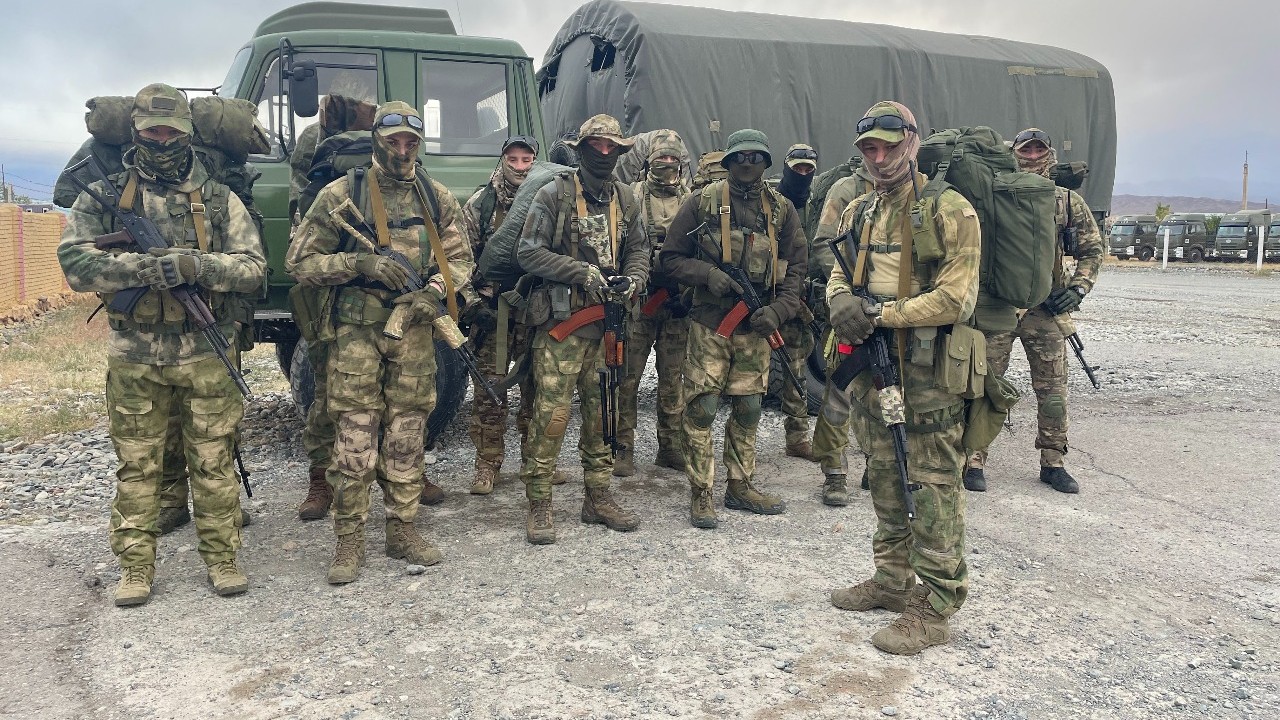
The Kabul Tribune (KT)—The Russia-led Collective Security Treaty Organization began military exercises in southeastern Kazakhstan focused on countering the possible infiltration of armed groups from Afghanistan into Central Asia, The Times of Central Asia reported.
The exercises began Sept. 12 in the Koktal area of Kazakhstan’s Zhetysu region and are scheduled to continue through Sept. 19. CSTO rapid reaction forces are conducting training in mountainous and desert terrain, including operations aimed at preventing armed groups from entering border areas.
The drills come amid renewed concerns from Russia and
Tajikistan about militant activity linked to Afghanistan.
Russian Defense Minister Andrei Belousov said Sept. 8 that
Moscow was paying particular attention to strengthening security along the
Tajikistan-Afghanistan border.
Tajikistan has previously called on other CSTO members for
additional assistance in protecting its border following several attacks it said
originated from Afghan territory. Five Chinese citizens and two Tajik border
guards were killed in attacks in late 2025, according to the report.
CSTO Secretary-General Taalatbek Masadykov said Aug. 28 that
the first shipment of equipment and weapons intended to strengthen Tajikistan’s
border would be sent this autumn.
The CSTO includes Russia, Belarus, Kazakhstan, Kyrgyzstan,
Tajikistan and Armenia. Tajikistan is the only member that shares a direct
border with Afghanistan.
The military exercises come despite growing engagement
between Central Asian governments and the Taliban since the group seized power
in Afghanistan in August 2021. Security concerns remain over the presence of
armed groups in Afghanistan, particularly Islamic State-Khorasan, or ISIS-K.
The United Nations estimates that between 15,000 and 20,000
fighters belonging to about 20 armed groups are operating in Afghanistan, while
Russia has put the figure as high as 23,000.
The Times of Central Asia reported that the current CSTO
exercises are not directed against the Taliban, which was viewed as a major
threat to Central Asian states during the 1990s.
Russia has formally recognized the Taliban government, while
Tajikistan, despite its historically critical position toward the group, has
also gradually established channels of communication with Kabul.
CSTO members have increasingly focused their security
concerns on militant groups such as ISIS-K. The group claimed responsibility
for the March 22, 2024, attack at the Crocus City Hall near Moscow, in which
more than 140 people were killed.
The possible movement of armed groups across Afghanistan’s
borders, drug trafficking and wider regional insecurity remain among the CSTO’s
main security concerns.