Introduction
The unresolved conflict in Indian Illegally Occupied Jammu
and Kashmir (IIOJK) represents far more than a territorial dispute between
India and Pakistan. According to a comprehensive analysis by the Kashmir
Institute of International Relations, the region has evolved into a structural
fault line within a nuclearized regional order, where political denial,
securitized governance, and structural coercion have replaced meaningful
political resolution. Since 1989, Kashmir has undergone a sustained
transformation into a heavily controlled space marked by extensive
militarization, legal exceptionalism, and systematic restrictions on civil and
political expression.
The Scale of Human Cost
The human toll of the Kashmir conflict is staggering.
Between January 1989 and February 2025, a total of 96,489 killings have been
recorded, with 7,415 occurring in custody or through staged encounter
scenarios. Beyond fatalities, more than 8,000 individuals have been forcibly
disappeared since 1989, many last seen in the custody of Indian troops. The
phenomenon of "half-widows" continues to define the lived reality of
thousands of women who remain uncertain about the fate of their spouses.
Mass detention has functioned as a parallel tool of control,
with 180,109 civilians arrested since 1989, often without transparent legal
processes. Alongside this, 110,563 homes and civilian structures have been
destroyed or damaged during operations conducted by Indian troops, reflecting
patterns of collective punishment that extend beyond individuals to entire
communities. The social consequences are profound: 22,991 women have been
widowed, 108,007 children have been orphaned, and 11,269 women have been subjected
to gang rape or molestation by Indian forces.
Post-August 5, 2019:
Legal Reconfiguration and Intensified Control
The period following August 5, 2019, represents a decisive
phase of intensified control, triggered by the unilateral revocation of Article
370 and Article 35A of India's Constitution. This move marked a significant
shift toward more direct and centralized governance, widely viewed as part of a
broader Indian colonial policy framework aimed at consolidating territorial
control rather than addressing the political aspirations of the Kashmiri
population.
An unprecedented enforcement regime accompanied this
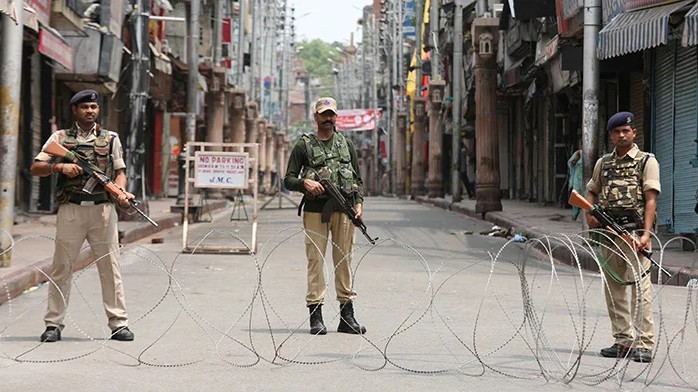
political re-engineering. A complete communications blackout was imposed,
severing internet and telecommunication access for months. Curfews and sweeping
restrictions on movement transformed everyday life into a controlled and
monitored environment. The deployment of more than 90,000 additional Indian
troops further intensified the militarization of civilian spaces.
Mass preventive detentions became a central instrument of
control, with more than 5,000 political leaders, activists, and lawyers
detained without charge. Many remained incarcerated for extended periods under
laws such as the Jammu and Kashmir Public Safety Act (PSA) and the Unlawful
Activities (Prevention) Act (UAPA), which enable prolonged detention without
trial and significantly limit access to bail and due process.
False Flag Operations and the Architecture of Control
Incidents such as the Pahalgam attack on 22 April 2025 are
immediately framed within a familiar script, with blame swiftly assigned beyond
borders before any independent investigation can begin. This rapid attribution
raises a serious contradiction: for years, India has insisted that
"normalcy" has been restored in IIOJK, claiming complete control
through one of the heaviest military deployments in the world. If total control
exists, infiltration becomes implausible; if infiltration is possible, then the
claim of normalcy collapses.
What followed Pahalgam was not a measured investigation but
a rapid expansion of force. Entire communities were subjected to raids,
detentions, and surveillance. Young Kashmiris were picked up without charge.
Homes were searched without warrants. Instead of identifying perpetrators
through due process, the response treated the population itself as suspect.
Following Operation Sindoor (May 2025), India launched a
series of named military operations across IIOJK, including Operation Mahadev,
Operation Shiva, Operation Shiv Shakti, Operation Akhal, and Operation Trishul.
These operations share a common pattern: individuals are killed, labeled
posthumously, and the narrative is closed. There is no trial, no evidence, and
no accountability.
Manufacturing
Normalcy Through Development
Since 2019, the policy direction has shifted toward a model
where "development" is deployed as a political instrument rather than
a neutral economic process. Railways, highways, tunnels, and dams form an
integrated system designed to reshape geography, regulate movement, and secure
long-term dominance. Projects such as the Udhampur-Srinagar-Baramulla Rail Link
(272 km), the Delhi-Amritsar-Katra Expressway, and various tunnel
infrastructures serve a dual purpose: enabling logistical access for military
deployment while embedding permanent strategic depth.
The removal of residency protections has enabled structural
demographic change. Under new domicile laws, individuals residing for 15 years
or meeting educational criteria can obtain permanent residency. Since 2019, 4.8
million domicile certificates have been issued to non-native individuals,
raising concerns about the dilution of indigenous identity and the alteration
of demographic composition.
Competing Regional Approaches
The geopolitical conduct of Pakistan and India during the
2024-2026 period reveals two sharply contrasting regional approaches. Pakistan
increasingly positioned itself as a diplomatic stabilizer, investing political
capital in mediation, humanitarian coordination, and crisis de-escalation
across multiple theatres. During the Gaza crisis, Pakistan emerged as one of
the few South Asian states actively participating in humanitarian diplomacy,
facilitating communication supporting humanitarian corridors and emergency
medical access.
In February 2026, following Israeli strikes connected to
Iranian targets, Pakistan immediately initiated diplomatic outreach to Tehran
and Washington, advocating urgent containment measures and proposing a
structured two-week ceasefire framework. The Islamabad Peace Talks (April
10-12, 2026) hosted high-level delegations connected to Iran and the United
States, providing a neutral venue for communication and indirect negotiation.
India, by contrast, expanded a posture centered on military
signaling, narrative management, and coercive governance in IIOJK. During the
Gaza crisis and the Iran-US-Israel escalation, India remained absent from every
meaningful humanitarian mediation or ceasefire architecture. Instead, New Delhi
restricted itself to carefully managed statements designed to avoid friction
with Israel while preserving domestic political messaging. Major Indian
television networks and digital platforms launched hostile narrative campaigns
against the Islamabad Peace Talks, demonstrating how India increasingly
weaponizes information spaces as instruments of geopolitical competition.
Nuclear Flashpoint and Persistent Instability
IIOJK stands as the most volatile unresolved territorial
dispute between two nuclear-armed states, where escalation compresses into rapid
military confrontation rather than gradual political escalation. Historical
episodes such as the Pulwama-Balakot crisis (2019) and the Pahalgam incident
(2024) demonstrate that localized incidents can rapidly escalate into direct
India-Pakistan confrontation within days.
The absence of a political settlement deepens this
instability. India continues to treat the dispute through a security lens
rather than a political one, relying on expanded legal restrictions,
communication control, and punitive frameworks such as UAPA and PSA to manage
dissent. The continued denial of political agency to Kashmiri civilians
sustains the underlying drivers of unrest, ensuring that instability remains
cyclical rather than resolved.
Conclusion
The evidence establishes a consistent pattern of unresolved
political conflict managed through securitized governance, strategic
infrastructure expansion, and narrative construction. Without a sustained
political settlement rooted in rights, representation, and accountability,
Kashmir will continue to function as a permanent ignition point within a
fragile nuclear environment, carrying consequences that extend far beyond South
Asia. The central reality remains unchanged: Kashmir is not merely a territorial
dispute but a strategic fault line whose stability, or instability, directly
shapes the security architecture of an entire region.
Kashmir: A Strategic
Fault Line in South Asia's Nuclear Landscape
Introduction
The unresolved conflict in Indian Illegally Occupied Jammu
and Kashmir (IIOJK) represents far more than a territorial dispute between
India and Pakistan. According to a comprehensive analysis by the Kashmir
Institute of International Relations, the region has evolved into a structural
fault line within a nuclearized regional order, where political denial,
securitized governance, and structural coercion have replaced meaningful
political resolution. Since 1989, Kashmir has undergone a sustained
transformation into a heavily controlled space marked by extensive
militarization, legal exceptionalism, and systematic restrictions on civil and
political expression.
The Scale of Human Cost
The human toll of the Kashmir conflict is staggering.
Between January 1989 and February 2025, a total of 96,489 killings have been
recorded, with 7,415 occurring in custody or through staged encounter
scenarios. Beyond fatalities, more than 8,000 individuals have been forcibly
disappeared since 1989, many last seen in the custody of Indian troops. The
phenomenon of "half-widows" continues to define the lived reality of
thousands of women who remain uncertain about the fate of their spouses.
Mass detention has functioned as a parallel tool of control,
with 180,109 civilians arrested since 1989, often without transparent legal
processes. Alongside this, 110,563 homes and civilian structures have been
destroyed or damaged during operations conducted by Indian troops, reflecting
patterns of collective punishment that extend beyond individuals to entire
communities. The social consequences are profound: 22,991 women have been
widowed, 108,007 children have been orphaned, and 11,269 women have been subjected
to gang rape or molestation by Indian forces.
Post-August 5, 2019:
Legal Reconfiguration and Intensified Control
The period following August 5, 2019, represents a decisive
phase of intensified control, triggered by the unilateral revocation of Article
370 and Article 35A of India's Constitution. This move marked a significant
shift toward more direct and centralized governance, widely viewed as part of a
broader Indian colonial policy framework aimed at consolidating territorial
control rather than addressing the political aspirations of the Kashmiri
population.
An unprecedented enforcement regime accompanied this
political re-engineering. A complete communications blackout was imposed,
severing internet and telecommunication access for months. Curfews and sweeping
restrictions on movement transformed everyday life into a controlled and
monitored environment. The deployment of more than 90,000 additional Indian
troops further intensified the militarization of civilian spaces.
Mass preventive detentions became a central instrument of
control, with more than 5,000 political leaders, activists, and lawyers
detained without charge. Many remained incarcerated for extended periods under
laws such as the Jammu and Kashmir Public Safety Act (PSA) and the Unlawful
Activities (Prevention) Act (UAPA), which enable prolonged detention without
trial and significantly limit access to bail and due process.
False Flag Operations and the Architecture of Control
Incidents such as the Pahalgam attack on 22 April 2025 are
immediately framed within a familiar script, with blame swiftly assigned beyond
borders before any independent investigation can begin. This rapid attribution
raises a serious contradiction: for years, India has insisted that
"normalcy" has been restored in IIOJK, claiming complete control
through one of the heaviest military deployments in the world. If total control
exists, infiltration becomes implausible; if infiltration is possible, then the
claim of normalcy collapses.
What followed Pahalgam was not a measured investigation but
a rapid expansion of force. Entire communities were subjected to raids,
detentions, and surveillance. Young Kashmiris were picked up without charge.
Homes were searched without warrants. Instead of identifying perpetrators
through due process, the response treated the population itself as suspect.
Following Operation Sindoor (May 2025), India launched a
series of named military operations across IIOJK, including Operation Mahadev,
Operation Shiva, Operation Shiv Shakti, Operation Akhal, and Operation Trishul.
These operations share a common pattern: individuals are killed, labeled
posthumously, and the narrative is closed. There is no trial, no evidence, and
no accountability.
Manufacturing
Normalcy Through Development
Since 2019, the policy direction has shifted toward a model
where "development" is deployed as a political instrument rather than
a neutral economic process. Railways, highways, tunnels, and dams form an
integrated system designed to reshape geography, regulate movement, and secure
long-term dominance. Projects such as the Udhampur-Srinagar-Baramulla Rail Link
(272 km), the Delhi-Amritsar-Katra Expressway, and various tunnel
infrastructures serve a dual purpose: enabling logistical access for military
deployment while embedding permanent strategic depth.
The removal of residency protections has enabled structural
demographic change. Under new domicile laws, individuals residing for 15 years
or meeting educational criteria can obtain permanent residency. Since 2019, 4.8
million domicile certificates have been issued to non-native individuals,
raising concerns about the dilution of indigenous identity and the alteration
of demographic composition.
Competing Regional Approaches
The geopolitical conduct of Pakistan and India during the
2024-2026 period reveals two sharply contrasting regional approaches. Pakistan
increasingly positioned itself as a diplomatic stabilizer, investing political
capital in mediation, humanitarian coordination, and crisis de-escalation
across multiple theatres. During the Gaza crisis, Pakistan emerged as one of
the few South Asian states actively participating in humanitarian diplomacy,
facilitating communication supporting humanitarian corridors and emergency
medical access.
In February 2026, following Israeli strikes connected to
Iranian targets, Pakistan immediately initiated diplomatic outreach to Tehran
and Washington, advocating urgent containment measures and proposing a
structured two-week ceasefire framework. The Islamabad Peace Talks (April
10-12, 2026) hosted high-level delegations connected to Iran and the United
States, providing a neutral venue for communication and indirect negotiation.
India, by contrast, expanded a posture centered on military
signaling, narrative management, and coercive governance in IIOJK. During the
Gaza crisis and the Iran-US-Israel escalation, India remained absent from every
meaningful humanitarian mediation or ceasefire architecture. Instead, New Delhi
restricted itself to carefully managed statements designed to avoid friction
with Israel while preserving domestic political messaging. Major Indian
television networks and digital platforms launched hostile narrative campaigns
against the Islamabad Peace Talks, demonstrating how India increasingly
weaponizes information spaces as instruments of geopolitical competition.
Nuclear Flashpoint and Persistent Instability
IIOJK stands as the most volatile unresolved territorial
dispute between two nuclear-armed states, where escalation compresses into rapid
military confrontation rather than gradual political escalation. Historical
episodes such as the Pulwama-Balakot crisis (2019) and the Pahalgam incident
(2024) demonstrate that localized incidents can rapidly escalate into direct
India-Pakistan confrontation within days.
The absence of a political settlement deepens this
instability. India continues to treat the dispute through a security lens
rather than a political one, relying on expanded legal restrictions,
communication control, and punitive frameworks such as UAPA and PSA to manage
dissent. The continued denial of political agency to Kashmiri civilians
sustains the underlying drivers of unrest, ensuring that instability remains
cyclical rather than resolved.
Conclusion
The evidence establishes a consistent pattern of unresolved political conflict managed through securitized governance, strategic infrastructure expansion, and narrative construction. Without a sustained political settlement rooted in rights, representation, and accountability, Kashmir will continue to function as a permanent ignition point within a fragile nuclear environment, carrying consequences that extend far beyond South Asia. The central reality remains unchanged: Kashmir is not merely a territorial dispute but a strategic fault line whose stability, or instability, directly shapes the security architecture of an entire region.
Jill Andrious is an experienced analyst and commentator
on South Asia and the Middle East. The views expressed in this article are
solely those of the author and do not necessarily reflect the editorial stance
of The Kabul Tribune.