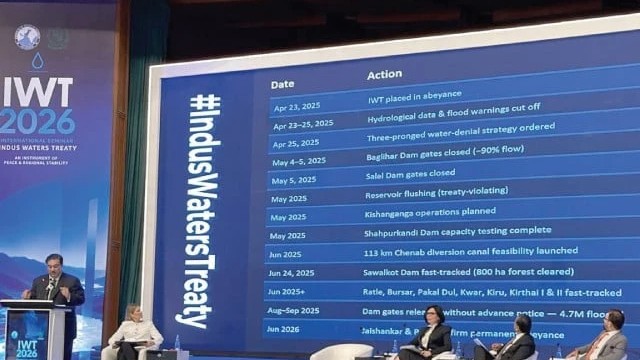
The Kabul Tribune (KT) — Pakistani and international experts reaffirmed the importance of the Indus Waters Treaty as a cornerstone of regional peace, stability and international legal cooperation during an international seminar held in Islamabad, calling for continued adherence to the treaty amid growing environmental and geopolitical challenges.
The seminar, titled “Indus Waters Treaty: An Instrument of
Peace and Regional Stability,” was jointly organized by Pakistan’s Ministry of
Information and Broadcasting and the Institute of Regional Studies. It brought
together government officials, diplomats, legal scholars, water experts,
policymakers and strategic analysts to examine the treaty’s legal,
humanitarian, environmental and strategic significance.
Participants described the 1960 Indus Waters Treaty as one
of the world’s most durable transboundary water-sharing agreements, noting that
it has remained operational despite decades of political tensions and armed
conflicts between Pakistan and India.
The discussions focused on the treaty’s role in conflict
prevention, institutional cooperation and the peaceful management of shared
water resources. Speakers said the agreement continues to provide legal
certainty and a framework for dialogue between the two neighboring countries.
A broad consensus emerged that unilateral attempts to
suspend, alter or place the treaty in abeyance would be inconsistent with its
legal framework and the principles governing international agreements.
Participants said respecting treaty obligations and resolving disputes through
established legal mechanisms are essential to maintaining the international
rules-based order.
Experts also highlighted the increasing importance of
cooperation over shared water resources as climate change accelerates glacier
melt, intensifies flooding and droughts, and increases pressure on regional
water security. They stressed the need for timely hydrological data sharing,
technical collaboration and institutional engagement to strengthen disaster
preparedness and protect downstream communities.
The seminar also examined the humanitarian dimensions of the
Indus River system, noting that it supports the livelihoods, agriculture,
economy and food security of more than 240 million people in Pakistan.
Participants said water should not be used as a political tool or instrument of
coercion, emphasizing that equitable and predictable management of shared
rivers is essential for sustainable development and lasting peace.
International experts said the challenges facing the Indus
Basin reflect broader global concerns over transboundary water governance. They
called for stronger international legal norms, enhanced cooperation among
riparian states and more effective institutional mechanisms to safeguard shared
freshwater resources.
Participants reaffirmed Pakistan’s commitment to addressing all treaty-related issues through the legal, institutional and diplomatic mechanisms provided under the Indus Waters Treaty and international law. They said constructive dialogue and good-faith implementation of treaty obligations remain the most effective path toward regional stability and mutual confidence.
The seminar concluded by emphasizing that preserving the
integrity of the Indus Waters Treaty carries significance beyond South Asia,
strengthening confidence in international law and supporting the peaceful and
sustainable management of shared natural resources worldwide.