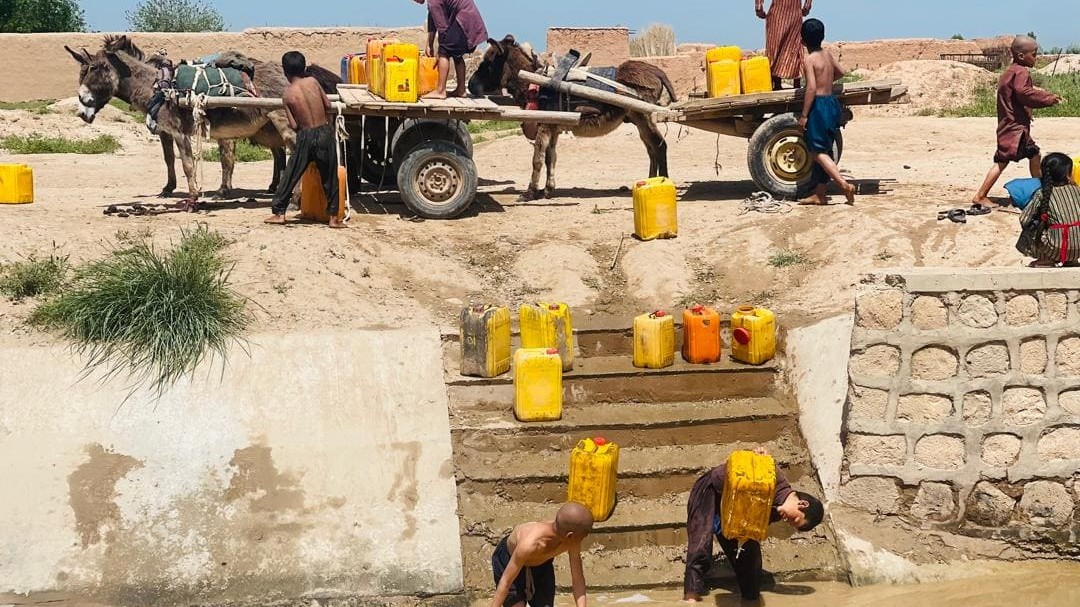
The Kabul Tribune (KT) — The International Committee of the Red Cross (ICRC) said that declining rainfall, falling groundwater levels and the return of millions of migrants have turned access to drinking water into a daily struggle for millions of people in Afghanistan.
The organization said access to safe and affordable water
has become severely limited in both urban and rural areas, forcing many
families to rely on unsafe surface water or travel long distances to collect
water.
According to the ICRC, women and children bear the greatest
burden, often spending hours fetching water instead of attending school or
carrying out other activities.
Major cities including Kabul, Kandahar and Mazar-i-Sharif
are also facing increasing pressure on water resources, driven by rapid
population growth and excessive groundwater extraction. In many areas, families
depend on private wells or water delivered by tankers.
The situation is described as particularly severe in
Kandahar, where many wells have dried up and water levels in others have
dropped to depths exceeding 100 meters.
A local elder, Fazl-ur-Rahman, from Kandahar’s District 9,
said water is the community’s most pressing issue, adding that even deep wells
fail to provide sufficient supply and many families cannot afford to dig their
own wells.
He said the crisis has also led to social consequences, with
some children missing school to help their families collect water, often
returning with only a few containers that do not meet daily needs.
The ICRC said it has implemented several projects to improve
water access, including an ongoing water supply system upgrade in Kandahar
expected to benefit about 106,300 people.
The organization added that its programs in 2025 improved
water access for more than 775,000 people in urban areas and around 160,300
people in rural communities.
Despite these efforts, the ICRC warned that the overall
situation remains critical. Water shortages have negatively affected
agriculture — a primary source of income for many — reducing irrigation and
crop yields and increasing the risk of food insecurity and malnutrition.
Limited access to clean water has also raised the risk of
waterborne diseases, particularly among vulnerable and displaced populations.
The organization further warned that water scarcity could
heighten tensions between communities over limited resources, especially in
drought-affected areas.
To address both immediate needs and long-term challenges,
the ICRC said it is rehabilitating irrigation systems, canals and traditional
karezes to improve water access and strengthen community resilience.
It also said that during recent crises, including after the
Kunar earthquake and cross-border tensions between Afghanistan and Pakistan, it
provided emergency water and sanitation services to more than 27,000 people.





