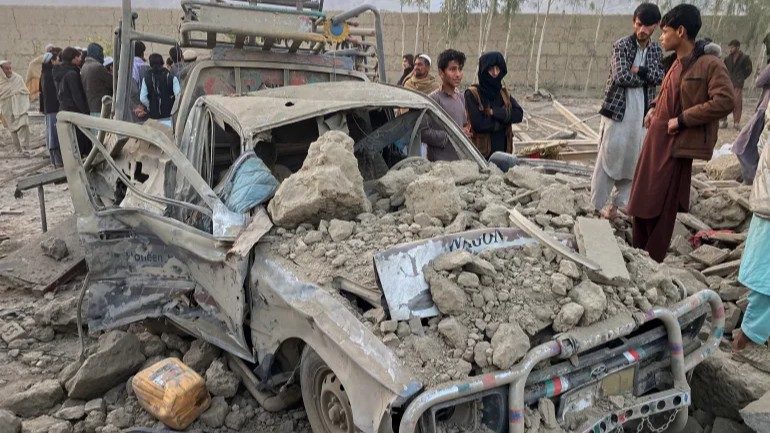
In the wake of military operations targeting militant hideouts in neighboring Afghanistan, Pakistani officials have firmly rejected allegations of civilian casualties and violations of sovereignty, characterizing the action as a necessary act of self-defense against cross-border terrorism.
A detailed statement released by official channels laid out
the rationale behind what it described as "intelligence-based, selective,
precision engagements" against elements of Fitna al Khawarij (FAK) and the
Islamic State Khorasan Province (ISKP). The government moved to counter what it
termed a "false and malicious narrative" emerging from Afghanistan.
Denial of Civilian Casualties
Contrary to reports from Afghan sources claiming that
civilians, including women and children, were killed, Pakistani officials
insisted the strikes were aimed at terrorist infrastructure. "The engaged
sites were terrorist camps and hideouts, not civilian infrastructure," the
statement asserted. It further accused militant groups of routinely using
non-combatants as human shields, stating that Pakistan's operational planning
accounts for this pattern to minimize collateral damage. The action was framed as
a "limited, proportionate response to an ongoing terror wave" inside
Pakistan.
Refuting Claims of Attacks on Religious Sites
Officials vehemently denied allegations that a mosque or
madrassa was struck, dismissing such reports as "fully fabricated fake
news for emotional exploitation." The statement highlighted Pakistan's
long-standing record of respecting all religious sites, even during conflict.
It argued that what terrorists designate as religious institutions are often
operational hubs, or marakiz, used for planning and launching attacks.
"The abuse of religious cover is their own desecration," the
statement read, adding that the same militant groups have a history of
attacking mosques and imambargahs in Pakistan.
Sovereignty and the Right to Self-Defence
Responding to accusations of unwarranted aggression against
Afghanistan's sovereignty, Pakistan framed its actions as a counterterrorism
measure narrowly focused on Pakistani terrorist leadership finding sanctuary
across the border. Officials noted that Islamabad had repeatedly raised its
concerns with Afghan authorities and pursued peaceful pathways, including
mediated tracks in Doha and Istanbul, without "substantive outcomes."
"The operative point is simple: sovereignty cannot be
used as a shield for cross-border terrorism," the statement declared,
adding that Pakistan would continue to act when imminent threats and direct
attack linkages were established.
Rejecting Claims of Security Failures
The government also pushed back against suggestions that it
was scapegoating Afghanistan for its own internal security shortcomings. To
underscore its commitment, officials cited data showing that in 2025 alone,
Pakistan conducted over 75,000 intelligence-based operations, eliminating 2,597
terrorists while sacrificing hundreds of personnel and civilians. "These
numbers demonstrate sustained, nationwide effort, not excuses," the
statement said, maintaining that the cross-border safe haven factor is an
"additional driver" of instability, not a substitute for internal
action.
Call for Afghan Clarity and Warning Against Retaliation
In a direct message to the interim Afghan government,
Pakistan urged it to take verifiable action against the FAK. "The only
durable solution is joint, verifiable action... the same type of clarity is
required at Taliban Regime's end," the statement asserted.
Addressing threats of retaliation from the Afghan side,
Pakistan warned that any hostile action enabling or protecting terrorists would
be viewed as "abetment of terrorism," prompting comprehensive
defensive measures. The offered path to de-escalation was clear: the
dismantling of militant camps and cooperation on verification to ensure no
further action becomes necessary.
Jill Andrious is an experienced analyst and commentator on
South Asia and the Middle East. The views expressed in this article are solely
those of the author and do not necessarily reflect the editorial stance of The
Kabul Tribune.