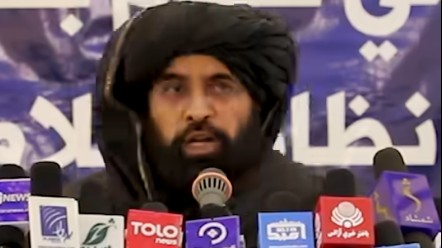
A leaked video of Taliban commander Ali Marjan Majroh has once again exposed the deep contradictions at the core of the Afghan Taliban’s claim to be the region’s moral and religious arbiter. In the footage—circulated widely across regional media—Majroh admonishes the Tehrik-i-Taliban Pakistan (TTP) and other insurgent factions for waging war against the Pakistani state. He stresses that attacking the Pakistani military is forbidden under Islamic law, a message that starkly contradicts the very ideology and violent legacy of the movement he represents.
But this sudden piety rings hollow.
Despite years of denials from Kabul, evidence—including
repeated findings by the United Nations Security Council—shows that thousands
of TTP fighters continue to find sanctuary on Afghan soil under Taliban rule.
The Taliban’s leadership may publicly insist that jihad must not spill beyond
Afghanistan’s borders, but the reality on the ground illustrates a far darker,
more calculated policy: a permissive environment for militants so long as their
guns are pointed outward.
This duplicity is no accident—it is strategy.
A “Pure” Emirate Built on Contradiction
The Taliban have meticulously crafted the mythology of a
pure Islamic Emirate, divinely mandated and morally superior to the “corrupt” republics
that surround it. Their spokesmen endlessly repeat that they have implemented
the only genuine Sharia-based system in the Muslim world.
Yet in Karachi earlier this year, Pakistan’s most prominent
Islamic scholars—from nearly every major school of thought—delivered a stunning
rebuke to that narrative. At a major religious conference, these scholars
warned of the erosion of Islamic principles inside Pakistan’s governance. Their
criticism unintentionally cast a glaring light on the Taliban’s own claim to
Islamic legitimacy: If there is no consensus among the region’s religious
authorities about what constitutes an “Islamic system,” how can the Taliban
insist theirs is the only one?
Worse still, the Taliban’s supposed commitment to peace
stops at the Afghan border. While their officials preach restraint, pro-Taliban
online networks aggressively push propaganda glorifying violence inside
Pakistan. These accounts idolize insurgency as a sacred struggle—so long as
it’s not against the Taliban themselves.
In Majroh’s leaked statement, the contradiction becomes
almost theatrical: a Taliban commander chastising militants for a style of
violence that the Taliban themselves used to seize power in 2021. The message
is clear: rebellion is only “un-Islamic” when it threatens their authority.
The Empire of Selective Morality
The Taliban’s claim to governing by Sharia is not built on
scholarly consensus or democratic mandate but on the raw monopoly of force.
Their interpretation of Islamic law is rigid when it consolidates power, but
flexible whenever geopolitics demands it.
They condemn attacks on Pakistan as un-Islamic—yet provide
refuge to those who carry them out.
They claim to oppose terrorism—yet host organizations
designated as terrorist by the international community.
They insist they do not interfere in regional affairs—yet
allow their territory to serve as a launchpad for violence abroad.
This is not an Islamic system.
This is statecraft wrapped in scripture.
The Region Cannot Afford This Ambiguity
Pakistan, already reeling from economic instability and
rising militancy, finds itself increasingly vulnerable. TTP attacks have surged
in recent years, and Islamabad’s attempts to negotiate with the group—often at
the urging of the Afghan Taliban—have failed disastrously. The Taliban’s
duplicity is no longer a matter of diplomatic inconvenience; it is a direct
threat to regional stability.
Majroh’s video, though brief, is a rare moment of public
contradiction from within the Taliban ranks. But it does not reflect a shift in
policy—only a shift in tone. Words cost nothing. Action would require
dismantling the very networks of militants who helped the Taliban secure
victory.
The international community must see the pattern for what it
is: a dual-track strategy where the Taliban preach peace while enabling
violence, claim religious legitimacy while ignoring religious consensus, and
present themselves as guardians of Islam while violating its principles for
political gain.
The Taliban insist they have brought order to Afghanistan.
But beyond their borders, they are sowing a dangerous
chaos—one sermon at a time.
Jill Andrious is an experienced analyst and commentator
on South Asia and the Middle East. The views expressed in this article are
solely those of the author and do not necessarily reflect the editorial stance
of The Kabul Tribune.