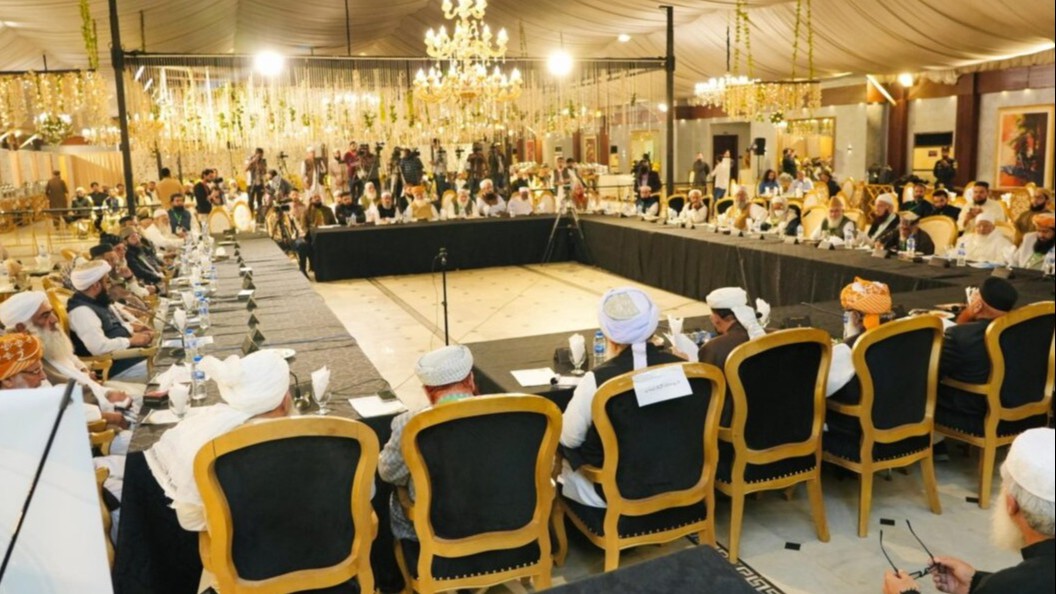
The recent conference in Karachi, where Pakistan’s leading Islamic scholars from all major schools of thought raised profound concerns about the erosion of Islamic principles in their country’s governance, has sent ripples across the region. This remarkable consensus highlights a fundamental debate about what constitutes a genuine “Islamic system.” Ironically, this very debate exposes the profound contradictions and selective hypocrisy of the Afghan Taliban regime, which claims to have established such a system in Afghanistan.
The Taliban’s narrative, aggressively propagated by its
media and supporters, is one of a pure, divinely mandated Islamic Emirate. Yet,
a clear-eyed analysis reveals a regime built not on popular mandate or
scholarly consensus, but on the monopoly of force and a rigid, exclusionary
interpretation that serves its own political authority.
A cornerstone of any legitimate Islamic governance
framework, as discussed by scholars in Karachi, is justice, consultation
(Shura), and the welfare of the people. The Afghan Taliban, however, seized
power through armed conquest, not through a democratic process or a broad-based
Islamic consensus. They dissolved the republic overnight and imposed their rule
without any mechanism to gauge the consent of Afghanistan’s diverse
populace—Pashtun, Tajik, Hazara, Uzbek, and others. To claim a divine mandate
while denying a popular one is a deep theological and political contradiction.
They govern not by the choice of the people, but over the people, imposing a
singular, tribalized version of Sharia that negates the rich pluralism of
Islamic jurisprudence so evident in the Pakistani scholars’ gathering.
The Afghan propaganda apparatus is keenly selective. It
eagerly amplifies any point from Pakistani religious scholars that criticizes
the Pakistani state, framing it as validation of their own stance. However, it deliberately
ignores the repeated and foundational argument made by these very same
scholars: that armed rebellion against a state has no religious justification. This
principle, a bedrock of Islamic political thought to prevent fitna (chaos),
directly undermines the Taliban’s original modus operandi and their ongoing
suppression of dissent. Pakistani scholars like Mufti Taqi Usmani have
consistently emphasized that reform must come through lawful, scholarly, and
peaceful means within a constitutional framework, not through insurrection. By
ignoring this critical consensus, the Taliban reveal that their interest is not
in Islamic scholarship per se, but in exploiting religious discourse for
political legitimacy and as a tool to criticize a neighbor.
The conference in Karachi was a testament to inclusive
dialogue—Deobandi, Barelvi, Ahl-i-Hadith, Shia, and others shared a platform.
This stands in stark contrast to the Taliban’s Afghanistan, where governance is
an exclusive monolith. There is no room for divergent Islamic interpretations,
no space for Shia, Salfis and Sufi scholarly voices in the halls of power, and
certainly no merit-based inclusivity. The government is a closed circle drawn
from a specific ethnic and ideological lineage, contradicting the Islamic merit
principle so fiercely defended by the Pakistani ulema regarding their own system.
Most glaring is the Taliban’s systematic negation of women’s
rights to education, work, and public life—a policy that places them far
outside the global consensus of Islamic scholars, including those in Pakistan.
The scholars in Karachi warned of “manipulation of religion and faith” and laws
that “render Islamic directives invalid.” What greater invalidation of Islamic
principle exists than denying half the population the right to contribute to
society, learn, and earn, contrary to the clear examples and injunctions from
the time of the Prophet Muhammad (PBUH)? The Taliban’s model is not a
protection of Islam; it is a suffocation of societal potential in Islam’s name,
a point on which Pakistani scholars across the board would find severe fault.
The heartfelt warnings from Pakistan’s scholars about
safeguarding Islam’s essence within a constitutional state ultimately hold a
mirror to Kabul. They underscore that a true Islamic system is measured by
justice, inclusivity, scholarly dialogue, and the upliftment of all people—not
by the severity of punishments, the breadth of restrictions, or the depth of
isolation.
The Afghan Taliban’s project is not the fulfillment of an
Islamic system, but its reduction to a tool of political control. They champion
the points of foreign scholars that suit their narrative while ignoring the
core principles those scholars uphold. They speak in the language of divine
mandate while silencing the voice of the people. Until the regime embraces the
inclusive, merciful, and consultative spirit that defines the best of Islamic
governance—as demanded by the scholars in Karachi for their own country—its
claims will remain a mirage, obscuring a reality of imposed will and deepening
isolation.
Jill Andrious is an experienced analyst and commentator
on South Asia and the Middle East. The views expressed in this article are
solely those of the author and do not necessarily reflect the editorial stance
of The Kabul Tribune.