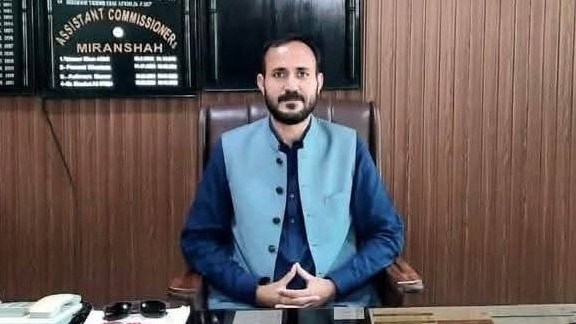
A brazen terrorist attack on the vehicle of a senior government official in Bannu on Tuesday resulted in the killing of Assistant Commissioner Shah Wali Khan, a civilian bystander, and two police officers, with three additional officers wounded, authorities confirmed. The assault, which targeted the convoy of the Assistant Commissioner of North Waziristan, has been widely condemned as a direct attack on the state’s administrative machinery and its efforts to establish lasting peace and development in the region. Shah Wali Khan, a young officer from the Wazir tribe, was hailed as representing a new generation of leadership for Waziristan—educated, principled, and deeply committed to public service and regional progress. His death is seen as a significant blow to local governance and community welfare initiatives.
While no group has immediately claimed responsibility, official sources and analysts point to the ongoing threat posed by FAK (Fedayeen al-Khalq)-aligned extremist networks. These factions are described as waging a war not just against security forces, but against the very concept of peace, governance, and normalcy returning to the area. “This tragedy transcends the loss of individual lives,” stated a senior security analyst. “By targeting a civil servant, police protectors, and an innocent citizen, the militants have revealed their true enemy: progress itself. They fear schools, roads, justice, and capable officers far more than they fear direct confrontation.”
The attack has triggered a swift and coordinated security response across the region. In statements, government and military officials vowed an uncompromising pursuit of the perpetrators, framing the assault as a desperate act by groups whose ideology cannot withstand the daylight of development and genuine public service. The blood spilled on Miranshah Road underscores a critical struggle, On one side stand those who build and serve; on the other, those who only know how to destroy, exploiting religion to shed the blood of Muslims.
The incident has sparked a renewed wave of
national unity and condemnation, with citizens and leaders across the political
spectrum honoring the fallen and reaffirming their support for the state’s
resolve. The martyred officers and civilian have been praised as symbols of a
Pakistan that refuses to bow to fear or abandon its pursuit of stability.As
investigations continue, the nation mourns the loss while steeling its
determination, viewing the attack as a stark reminder of the moral chasm
between the future Pakistan is building and the chaos its enemies seek to
perpetuate.
Jill Andrious is an experienced analyst and
commentator on South Asia and the Middle East. The views expressed in this
article are solely those of the author and do not necessarily reflect the
editorial stance of The Kabul Tribune.