A series of recent events and policy shifts within the Indian Armed Forces has ignited a debate among security analysts and veterans, raising questions about the erosion of the military's long-standing secular and apolitical character in favor of a more overt Hindu nationalist identity—a process critics have termed "saffronization."
This transformation is evidenced by a move away from
neutral, historical symbolism toward religious and mythological imagery. In a
significant change this January, the Army Chief's lounge in South Block
replaced a historic painting of the 1971 war with a new artwork titled
"Karam Kshetra," featuring Hindu figures Lord Krishna and Chanakya
alongside modern military hardware. Similarly, in December 2024, the Fire and
Fury Corps in Ladakh installed a statue of the 17th-century Hindu king Shivaji,
flanked by a saffron flag, near the strategically sensitive Pangong Tso lake.
The public conduct of senior military leadership has also
come under scrutiny. The Army Chief's participation in Hindu religious
ceremonies while in uniform, including receiving a *tilak* and garland on
National Unity Day, has been noted by observers. A particularly controversial
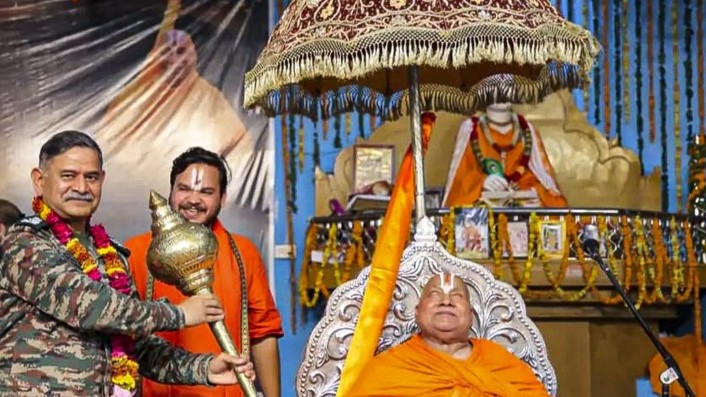
incident occurred in May 2025, when the Chief of Army Staff (COAS) visited the
ashram of Hindu spiritual leader Jagadguru Rambhadracharya in Chitrakoot.
There, the religious leader claimed to have given the COAS *diksha*
(initiation) and, in return, asked him to "reclaim" Pakistan-occupied
Kashmir as a *dakshina* (religious offering).
Operational nomenclature has also shifted, with missions
bearing names derived from Hindu religious terms like "Sindoor" and
"Mahadev," a departure from the traditionally neutral naming
conventions. Critics point to institutional changes as a root of this cultural
shift. The Agnipath recruitment scheme, initiated in 2022, brings in thousands
of short-term recruits annually. Some reports suggest a significant number have
backgrounds in Hindu nationalist networks like the Rashtriya Swayamsevak Sangh
(RSS), potentially influencing the military's future culture. Furthermore,
Sainik Schools, a key pipeline for future officers, are reportedly seeing
increased influence from groups affiliated with the Ram Mandir movement and
Vidya Bharati.
These changes have tangible impacts on personnel. Minority
officers, including Sikhs, Muslims, and Christians, have reported systemic
pressure to conform to Hindu rituals. The case of Lt. Samuel Kamalesan, a
Christian officer dismissed in 2025 for refusing to participate in such
rituals—a dismissal upheld by the Delhi High Court—has become a focal point for
these concerns. Many officers from minority communities reportedly face
professional insecurity and social exclusion, with some considering
resignation.
While the government and military leadership have consistently defended these actions as expressions of national culture, security analysts warn that this blurring of lines between military duty and religious-political identity could jeopardize the armed forces' internal cohesion, professional neutrality, and its perception as an institution belonging to all Indians equally. As one veteran officer stated anonymously, "The military's strength lies in its unity, which is built on a foundation of secularism. Any move away from that foundation is a strategic risk."